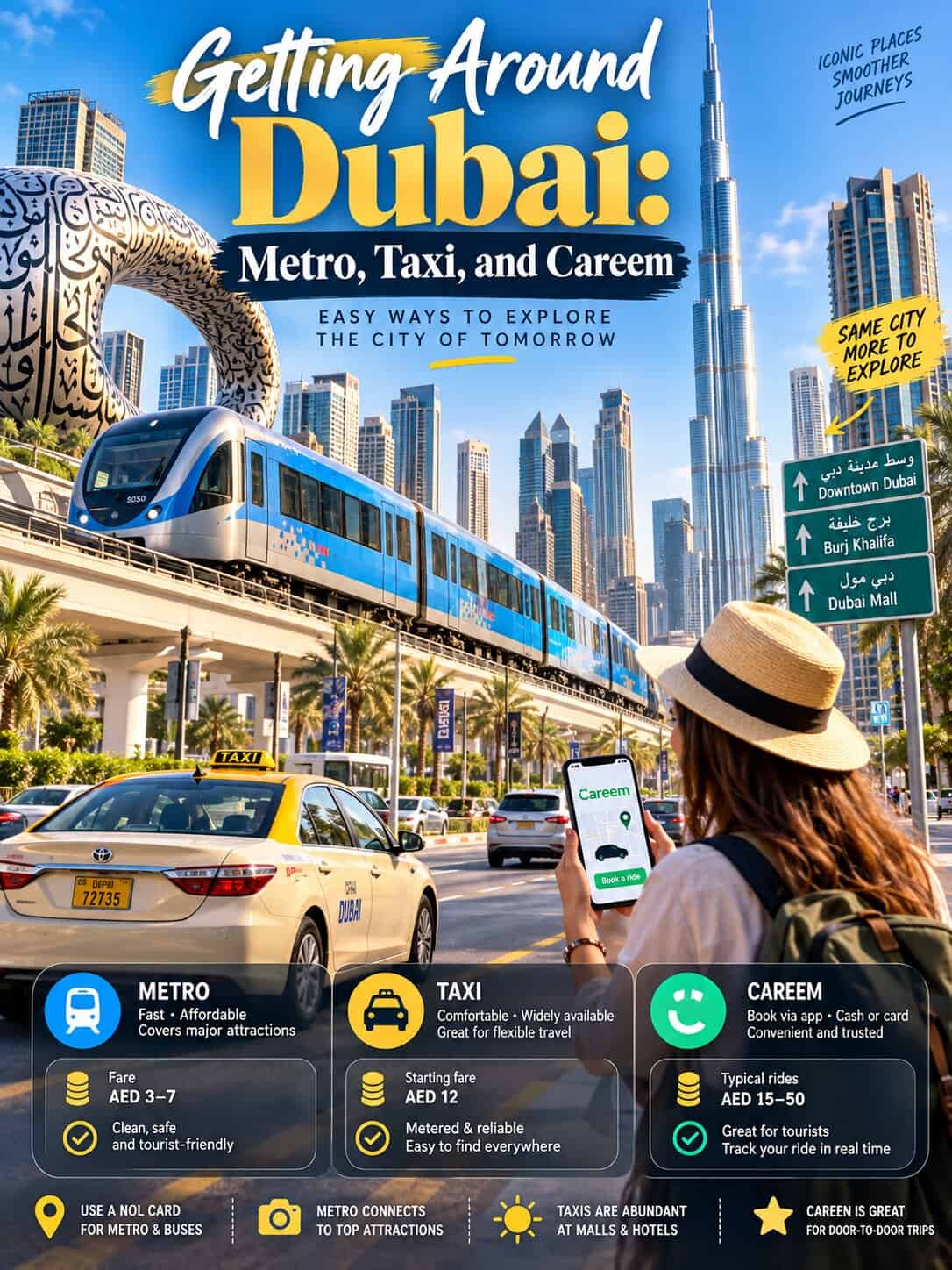
Quick answer: Dubai Metro and tram fares on a Silver nol card are AED 3, 5 or 7.50 depending on the zones crossed. An official taxi costs AED 5–5.50 flagfall plus AED 2.45 per km, and a regular Creek abra crossing costs AED 2.
Dubai public transport includes the Metro Red and Green Lines, Dubai Tram, RTA buses, Creek abras, ferries and regulated taxis. This getting around Dubai guide compares official fares, transport connections, nol cards, Careem Hala, taxi charges and route choices for Downtown, Dubai Marina, JBR, the airport and Old Dubai. The cheapest option depends on where you are going, how many people are travelling and whether you can complete the journey with one nol fare. None of this requires advance planning — you can mix and match day to day once you land, building on the neighborhood overview in our Dubai: The Complete Guide.
Dubai Metro: The Backbone of Getting Around Dubai
For most visitors, the Dubai Metro is the single best tool for getting around Dubai — it’s clean, driverless, air-conditioned, and runs along two lines that cover a surprising amount of the tourist map. The Red Line is the one you’ll use most, running along Sheikh Zayed Road past Dubai Marina, Mall of the Emirates, Downtown Dubai and Burj Khalifa, and on to Deira and the airport terminals. The Green Line crosses it to serve Old Dubai, the Gold Souk, and the Dubai Creek area, including the Al Fahidi and abra crossing covered in our Old Dubai Guide. You’ll need a Nol card, sold from vending machines at every station, with fares based on how many zones you cross — a short single-zone trip runs roughly AED 3-4, while crossing multiple zones (say, Marina to Old Dubai) runs closer to AED 7.50-8.50. Gold Class Metro fares are double Silver fares, not AED 2 extra. The current zone-based Silver fares are AED 3, AED 5 and AED 7.50; Gold fares are AED 6, AED 10 and AED 15. Gold sections are specially marked, and paying the premium does not guarantee a seat. RTA publishes regular Metro operating hours of 5 AM–midnight Monday–Thursday; 5 AM–1 AM the following day Friday; 5 AM–midnight Saturday; and 8 AM–midnight Sunday. Services can be different on special events and public holidays, and train frequency depends on time, line and branch. The official RTA website has the full fare table and live route planner if you want to double-check a specific trip. Our dedicated Dubai Metro Guide goes deeper on routes, prices, and tourist-specific tips if the Metro is going to be your main way of getting around.
Dubai Public Transport: Compare Modes and Costs
| Mode | Current published fare basis | Best for |
|---|---|---|
| Dubai Metro | Silver nol AED 3 / 5 / 7.50 | DXB T1/T3, Downtown, Mall of the Emirates and Marina |
| Dubai Tram | Silver nol from AED 3; integrated transfers apply | Marina, JBR and Palm Gateway |
| RTA buses | Zone-based nol fare | Attractions beyond rail stations |
| Official Dubai taxi | AED 5–5.50 street flagfall + AED 2.45/km | Door-to-door, families and luggage |
| Careem Hala | Metered taxi with e-hail starting charges | Booked official taxi pickups |
| Creek abra | AED 2 regular commuter crossing | Old Dubai and Deira souks |
| Dubai Ferry / water taxi | Individual route fare | Waterfront travel and sightseeing |
Taxis: Reliable, Metered, Everywhere
Official RTA taxis are a dependable fallback whenever the metro doesn’t reach your exact destination or you’re traveling with a group and luggage. They’re metered and well-regulated, so there’s no haggling. Dubai Taxi Company’s current street-hail rates are AED 5 flagfall from 6 AM to 10 PM, AED 5.50 from 10 PM to 6 AM, and AED 2.45 per kilometre. Its street-hail minimum fare is AED 12. App-booked regular taxis have higher starting charges: AED 9 during standard periods, AED 13 during peak periods (8–10 AM and 4–8 PM Monday to Thursday, 8–10 AM and 4 PM–midnight on Friday, 4 PM–midnight on Saturday and Sunday) and AED 10 overnight, with an AED 13 minimum. Airport taxi pickups have a different tariff: the meter starts at AED 20 at Dubai Airports, or AED 25 for a van, and then runs at AED 2.62 per kilometer. Waiting, tolls and special-event pricing can add to the fare. Salik uses variable pricing rather than a fixed AED 5 for each toll gate. Under the published standard schedule, weekday peak crossings cost AED 6, normal off-peak crossings AED 4, and crossings from 1 AM to 6 AM are free; Sunday, holiday and Ramadan arrangements differ. Dubai Taxi Company lists a waiting charge of AED 0.50 per minute. Taxis can be hailed on the street in busy areas, picked up from ranks at malls and hotels, or booked through the RTA’s own app for a small booking fee.
Dubai Taxi: Street-Hail vs App-Booking Prices
| Fare component | Dubai Taxi Company charge |
|---|---|
| Street hail 6 AM–10 PM | AED 5 starting fare |
| Street hail 10 PM–6 AM | AED 5.50 starting fare |
| App booking normal period | AED 9 starting fare |
| App booking designated peak periods | AED 13 starting fare |
| App booking overnight | AED 10 starting fare |
| All regular taxi types | AED 2.45/km and AED 0.50/min waiting |
| Minimum total fare | AED 12 street / AED 13 app |
These figures apply to the regular taxi product. Airport pickups, premium cars, major events and tolls have separate rules. Dubai Taxi Company also accepts cash, bank cards and nol cards for ordinary taxi fares.
Careem and Uber vs Dubai Public Transport
Careem and Uber both operate widely across Dubai and are a popular way of getting around Dubai for travelers who prefer app-based booking, upfront pricing, and not needing cash on hand. Careem, originally a Dubai-based company, offers the widest range of categories — Economy for a standard ride, Business and First Class for higher-end vehicles, MAX for six-seater groups, and even Careem Electric for a Tesla-style ride — plus Hala, which lets you book an official RTA taxi directly through the Careem app. Careem is not consistently cheaper than Uber on every journey. Compare current prices for the same pickup, destination, time and vehicle category. Careem Hala books an official metered Dubai taxi, while other Careem and Uber services may use differently priced cars. Bolt also supports authorised Dubai taxi bookings. Peak demand, pickup fees and vehicle type affect the result.
Dubai Public Transport: The Dubai Tram
If your trip is centered on Dubai Marina and JBR, the Dubai Tram is a convenient, often-overlooked piece of the getting-around-Dubai puzzle. It runs 10.6 kilometers along Al Sufouh Road, linking Dubai Marina, Jumeirah Beach Residence, Jumeirah Lakes Towers, and Media City, with a connection to the Palm Monorail for Palm Jumeirah. The Dubai Tram connects to the Metro Red Line at Sobha Realty and DMCC, the current names used in RTA’s official timetable. The older Dubai Marina and Jumeirah Lakes Towers Metro station names should not be used as the main directions. The Tram also links with Palm Gateway for onward travel on the separately ticketed Palm Jumeirah Monorail. A standalone short Dubai Tram journey typically costs AED 3 with a Silver nol card or AED 4 with a regular Red Ticket. The tram is part of the zonal RTA fare network: a qualifying Metro-to-Tram transfer within 30 minutes can count within one combined journey. Official Tram operating hours are 6 AM–1 AM the next day Monday–Saturday, and 9 AM–1 AM the next day Sunday. Full details on the Marina and JBR area itself are in our Dubai Marina & JBR: The Complete Visitor’s Guide.
Dubai Public Transport Operating Hours
| Day | Metro | Tram |
|---|---|---|
| Monday–Thursday | 5 AM–midnight | 6 AM–1 AM next day |
| Friday | 5 AM–1 AM next day | 6 AM–1 AM next day |
| Saturday | 5 AM–midnight | 6 AM–1 AM next day |
| Sunday | 8 AM–midnight | 9 AM–1 AM next day |
Special events and holidays can change the timetable. The last train serving your individual station may leave before the network’s advertised closing time.
Dubai Public Transport Buses
RTA buses connect neighbourhoods, beaches and attractions that the Metro and Tram do not reach. Buses share Dubai’s zone-based nol fare system. A qualifying transfer to or from Metro or Tram within 30 minutes counts as part of the overall journey rather than automatically requiring a new full fare. The RTA S’hail planner shows routes, stops and service times. They’re the cheapest option by a wide margin, but routes and frequency are harder to plan around for a short visit without local knowledge, so most travelers reach for the Metro or a taxi first and treat buses as a budget option for specific, well-researched routes rather than a default choice.
nol Card Fares and the 30-Minute Transfer Rule
| Ticket type | One zone | Two adjacent zones | More than two zones |
|---|---|---|---|
| Silver nol | AED 3 | AED 5 | AED 7.50 |
| Gold nol | AED 6 | AED 10 | AED 15 |
| Regular Red Ticket | AED 4 | AED 6 | AED 8.50 |
| Seven-day Silver pass | AED 50 | AED 80 | AED 110 |
A Silver nol card costs AED 25 including AED 19 credit, and RTA states that at least AED 7.50 must be available for Metro entry. Top-ups at Metro ticket machines start at AED 20, and children aged 5 and under travel free. For a longer stay, a 30-day Silver pass costs AED 140 for one zone, AED 230 for two zones and AED 350 for all zones, but it needs a registered card; an anonymous Silver card can only hold the seven-day pass. To combine Metro, Tram or bus services in one journey, tap the same card out of the first service and into the next within 30 minutes. Up to three qualifying transfers can be counted within a maximum journey time of 180 minutes, with the final price calculated by zones rather than always charging two independent full fares.
Dubai Public Transport by Abra and Water
The traditional abra is an affordable way to cross Dubai Creek, but RTA’s published commuter routes now cost AED 2 per person, including Al Sabkha–Al Fahidi (CR4) and Al Fahidi–Deira Old Souq (CR5). Private electric abra tours, water taxis and ferry journeys are different services with different ticket prices. An air-conditioned water taxi option also runs between Al Jadaf Marine Station and Dubai Festival City for AED 2 per person. These won’t replace the Metro for cross-city trips, but they’re a practical and charming option if your route happens to cross the Creek, detailed further in our Old Dubai Guide linked above.
Getting Around Dubai: AED 2 Abra Routes
| Route | Stops | Fare |
|---|---|---|
| CR3 | Dubai Old Souq – Baniyas | AED 2 |
| CR4 | Al Sabkha – Al Fahidi | AED 2 |
| CR5 | Al Fahidi – Deira Old Souq | AED 2 |
| CR6 | Al Seef – Baniyas | AED 2 |
| CR9 | Dubai Festival City – Dubai Creek Harbour | AED 2 |
| BM2 | Al Jaddaf – Dubai Festival City | AED 2 |
The traditional Creek crossing is different from a private abra charter, which costs considerably more. At the commuter abra stations you can pay with cash, nol or a credit or debit card, and children under 5 ride free. Commuter abras do not run through the night: CR4 between Al Sabkha and Al Fahidi, for example, operates from 8 AM to 11:25 PM Monday to Thursday and starts at 10 AM on Sunday. The RTA ferry and water taxi routes have their own prices and schedules. Select the correct dock on both banks of Dubai Creek before boarding.
Renting a Car vs Dubai Public Transport
Renting a car may be useful for journeys outside central Dubai, but compare parking, fuel, insurance, deposits and Salik charges. The Salik system uses variable toll rates: generally AED 6 weekday peak, AED 4 other standard paid periods and free overnight from 1 AM to 6 AM, subject to special rules. Do not assume every mall offers unlimited free parking or every toll gate is charged AED 5. It becomes a genuinely good option for day trips outside the city — to Abu Dhabi, Hatta, or the desert — where public transport options thin out considerably.
Choosing the Right Option for Your Trip
The short version for getting around Dubai: take the Metro for any trip between stations on the Red or Green Line, especially during rush hour when road traffic on Sheikh Zayed Road slows considerably; switch to the Tram once you’re in the Marina/JBR area; reach for a metered taxi or Careem when your destination is off the rail network, you’re carrying luggage, or it’s simply more convenient; and save the abra for when you’re already exploring Old Dubai on foot.
Dubai Public Transport: Best Routes for Tourist Attractions
| Destination | Transport | Extra consideration |
|---|---|---|
| Burj Khalifa and Dubai Mall | Red Line to Burj Khalifa/Dubai Mall | Enclosed walkway to the mall |
| Dubai Marina | Red Line to Sobha Realty or DMCC | Tram for surrounding Marina stops |
| JBR Beach | Red Line then Dubai Tram | Walk from JBR tram stop |
| Palm Jumeirah | Red Line, Tram and Palm Monorail | Monorail is a separate fare |
| Gold Souq and Al Fahidi | Green Line and optional abra | Walk and cross Creek as needed |
| DXB Airport Terminals 1 and 3 | Red Line | Not a 24-hour Metro service |
| DXB Terminal 2 | Bus connection or taxi | No direct Metro station |
| Global Village | Seasonal bus or taxi | Confirm operating season |
For multi-stop travel, enter the actual locations into RTA’s S’hail trip planner. Choose taxi for very late arrivals, heavy suitcases or locations with long last-mile walks.
Getting Around Dubai: Quick Reference
Dubai public transport quick reference: Metro Silver nol AED 3/5/7.50 by zone; Gold AED 6/10/15; Red Ticket AED 4/6/8.50 per ride plus ticket cost. Tram: normally AED 3 Silver for one zone; eligible combined Metro–Tram journeys may share a fare. Street taxi: AED 5 daytime / AED 5.50 nighttime flagfall, AED 2.45/km and AED 12 minimum. App-booked taxis have different starting charges. Careem/Uber: compare live quotes. Standard Creek abra: AED 2 per person.
Frequently Asked Questions
What’s the cheapest way of getting around Dubai?
RTA’s standard Dubai Creek abra crossings currently cost AED 2 per passenger. For longer journeys, Metro and RTA buses generally provide the lowest public transport fares, and qualifying connections within 30 minutes can count as a single zone-based journey.
Is the Dubai Metro easy for tourists to use?
Yes — stations and trains have clear English signage, a Nol card is simple to buy and top up at any station, and the Red Line in particular connects most major tourist areas, from Dubai Marina to Downtown Dubai to the airport.
Is Careem or Uber cheaper in Dubai?
There is no reliable fixed ranking between Careem and Uber. Compare prices at booking time; Careem Hala offers official metered taxis, while other vehicle classes have different prices. A street-hail taxi may have a lower starting charge than an e-hail.
Does the Dubai Tram connect to the Metro?
Yes — the Tram connects to the Metro Red Line at two points: Dubai Marina station links to Sobha Realty station, and Jumeirah Lakes Towers station links to DMCC station.
Do I need a car to get around Dubai?
No. The combination of Metro, Tram, taxis, and Careem/Uber covers the vast majority of visitor trips within the city. A rental car is more useful for day trips outside Dubai than for getting around the city itself.
How much does a taxi cost in Dubai?
Dubai Taxi Company lists AED 12 as the street-hail minimum and AED 13 as the e-hail minimum, AED 2.45 per kilometre, AED 5 daytime or AED 5.50 nighttime street-hail starting fare and variable Salik charges. App-booked starting fares depend on the hour and day.
How much does Dubai public transport cost?
A Silver nol card charges AED 3, AED 5 or AED 7.50 by zone. A regular Red Ticket costs AED 4, AED 6 or AED 8.50 per trip, plus the ticket purchase.
Can I transfer from Dubai Metro to a bus for free?
An eligible transfer within 30 minutes counts towards a single zone-based fare, rather than automatically paying a second full fare. It is not an unlimited free ride.
How much does a Dubai taxi cost per kilometre?
The current standard Dubai Taxi Company rate is AED 2.45 per kilometre, plus the starting fare, waiting charge and any tolls.
Is Careem cheaper than Uber?
Not consistently. Compare actual app quotes, especially during events and peak travel hours. Careem Hala also books official taxis.
How much is a Dubai Creek abra?
RTA’s standard Creek commuter routes cost AED 2 per person, including Al Fahidi to Deira Old Souq.
What time does Dubai Metro start on Sundays?
8 AM. Dubai Tram begins at 9 AM on Sundays.
Can I reach Dubai Marina and JBR by public transport?
Yes. Take the Red Line to Sobha Realty or DMCC and transfer to Dubai Tram for the JBR area.
Do I need a rental car in Dubai?
Most city attractions are accessible by Metro, buses, tram or taxi. A car is more useful for distant day trips or a multi-emirate itinerary.
Are Salik tolls always AED 5?
No. The standard system uses AED 6 peak and AED 4 off-peak rates, with a free overnight window and special timetable rules.
Getting around Dubai is simplest with a nol card for Metro, Tram and buses, with Hala or a licensed taxi for door-to-door journeys and an AED 2 abra for the historic Creek crossing. Plan around the 30-minute integrated-transfer rule, current Metro operating hours and different street-hail versus app taxi charges. This makes Dubai public transport both affordable and practical for most city sightseeing.