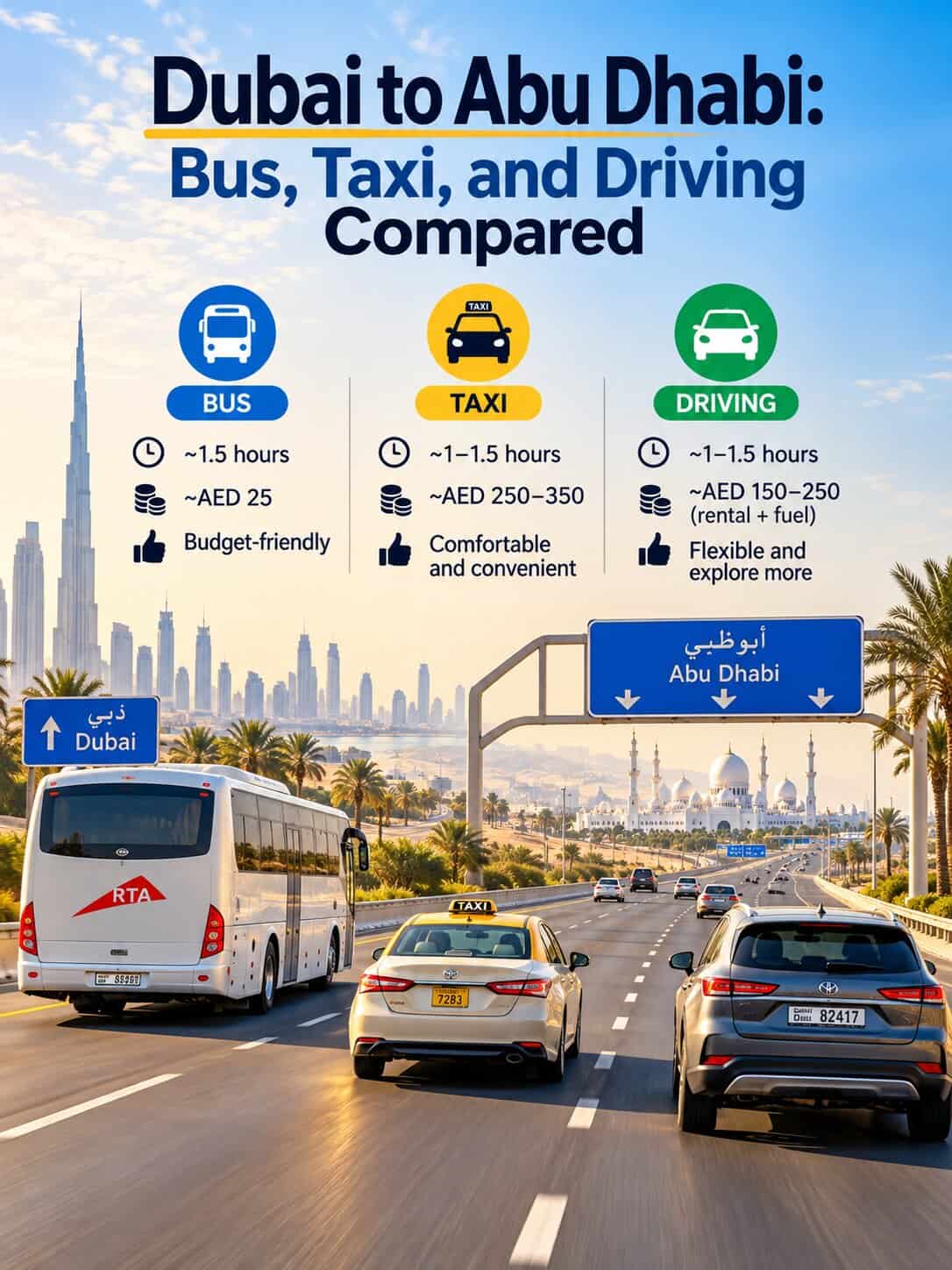
Dubai to Abu Dhabi is one of the most common routes in the whole country — a straightforward 140-kilometer hop between the UAE’s two biggest cities that thousands of residents and visitors make every single day. Whether you’re doing a day trip, splitting a longer stay between both cities as in our Dubai + Abu Dhabi 7-Day Itinerary, or just deciding how to get there and back, the choice now comes down to five options: a brand-new direct train, bus, taxi, ride-hailing, or driving yourself. Here’s exactly how they compare on cost, time, and convenience.
Dubai to Abu Dhabi Bus: E100 and E101
The RTA’s E100 bus is the cheapest way to make this trip by a wide margin, running between Al Ghubaiba Bus Station in Dubai and the Abu Dhabi Central Bus Station. A Dubai to Abu Dhabi bus ticket is priced at AED 30 on the RTA journey planner for the E100; Heading back, Abu Dhabi Mobility lists AED 25 for inter-emirate buses from Abu Dhabi Central Bus Station toward Dubai, with tickets sold at the station’s customer service offices. The E100 journey usually takes around two hours, depending on traffic. The E100 operates between Al Ghubaiba and Abu Dhabi Central Bus Station, while the E101 connects Ibn Battuta with the same Abu Dhabi terminus. Seats on both routes can be reserved in advance through RTA’s intercity e-ticket service, which also gives you a dedicated boarding lane and a separate seating area at the station. From Abu Dhabi Central Bus Station, continue by local bus or taxi to your destination; Abu Dhabi does not have a passenger metro system.
Dubai to Abu Dhabi by Etihad Rail Train
Since September 30, 2026, there’s been a genuinely fast new way to make this trip: Etihad Rail’s direct passenger service between Al Yalayis Station in Dubai (in Me’aisem First, next to Jumeirah Golf Estates, home to a couple of the resorts in our Best Golf Resort Hotels in Dubai guide) and Mohamed bin Zayed Station in Abu Dhabi. The journey takes 57 minutes. Fares depend on the date and class, and the Etihad Rail site shows the current price; both classes offer WiFi, but in Comfort food and drinks are sold from an onboard trolley, while Premium includes complimentary refreshments, with more items available for purchase. Departure times and fares depend on the date, and tickets are sold online through Etihad Rail’s website. Al Yalayis Station connects directly to the Dubai Metro Red Line via a covered 400-meter walkway, so reaching it from most parts of the city doesn’t require a car. For speed and comfort per dirham, it’s an instant front-runner against every other option below — the main trade-off is that both stations sit outside the two cities’ downtown cores, so budget a short taxi, metro, or rideshare leg on each end.
Dubai to Abu Dhabi by Taxi
A metered taxi is the most popular way to go for travelers who want door-to-door convenience without paying premium ride-hailing rates. Expect to pay roughly AED 250-300 one-way from central Dubai, with the meter running on the same structure as an in-city ride — a daytime flagfall around AED 5 (AED 5.50 after 10pm) plus AED 2.45 per kilometer and any Salik tolls, which adds up quickly over 140 km. The trip itself takes about 1 hour 50 minutes under normal traffic. Taxis can be hailed at ranks outside major hotels and malls, or booked in advance through the RTA app if you want to lock in a pickup time, which is worth doing if you have a flight or appointment to catch on the other end.
Careem and Uber: Pricier, But Door-to-Door
Careem and Uber offer app-based door-to-door transfers between Dubai and Abu Dhabi. Prices depend on pickup point, destination, demand and vehicle category, so compare live estimates with a metered taxi before booking. The appeal is upfront pricing, a confirmed pickup time, and not needing to flag anything down, which can be worth it for a group splitting the cost across several passengers or for travelers who’d simply rather book from an app than negotiate a taxi.
Driving from Dubai to Abu Dhabi
Self-driving is the most flexible way to make this trip, particularly if you’re planning stops along the way or a multi-destination day trip rather than a straight there-and-back. The main route is the E11 (Sheikh Zayed Road), which runs southwest out of Dubai past Jebel Ali and continues into Abu Dhabi; the E311 (Sheikh Mohammed Bin Zayed Road) runs further inland and is a useful alternative when the E11 is congested. The drive covers about 140 km and takes roughly 1.5 hours in normal traffic — a bit less, around 1 hour 10 minutes, if Yas Island rather than the city center is your destination. You’ll pass through Salik toll gates leaving Dubai (roughly AED 4 off-peak or AED 6 during peak hours, billed automatically to a rental car’s account, and free between 1am and 6am), and once you’re on Abu Dhabi’s bridges the Darb toll system charges AED 4 per gate Monday through Saturday from 7am to 9am and 3pm to 7pm, with Sundays and public holidays free. Rental cars can usually be driven between Dubai and Abu Dhabi, but confirm the rental company’s permitted driving areas, insurance conditions and toll charges before departing. Fuel and rest stops (ENOC and ADNOC) are available at regular intervals, speed limits are strictly enforced with frequent cameras on both sides of the border, and winter mornings can bring fog on this stretch, so it’s worth leaving a little extra time and keeping headlights on if visibility drops.
Dubai to Abu Dhabi: Which Option Fits Your Trip?
For most travelers, Etihad Rail is worth considering for a fast station-to-station journey, while the Dubai to Abu Dhabi bus is a practical budget option. A metered taxi or app-booked car is usually simpler for door-to-door travel, particularly with luggage or several passengers. Driving yourself is worth it specifically when you want the freedom to stop at places like Yas Island or a roadside break along the way, or when you’re combining the trip with other stops as part of a longer UAE road trip — otherwise, for a straightforward transfer between the two cities, the train or a taxi will usually serve you better. For more on how the two cities compare beyond just the trip itself, see our Dubai vs Abu Dhabi comparison.
Dubai to Abu Dhabi Transport Comparison
Train (Etihad Rail): 57 minutes between stations; fares depend on the date and class. Bus: E100 from Al Ghubaiba or E101 from Ibn Battuta; AED 30 on the E100 from Dubai and AED 25 for buses back from Abu Dhabi. Taxi: metered at AED 2.45 per kilometer plus tolls, roughly AED 250-300 from central Dubai. Ride-hailing: live app quote for your exact addresses. Driving: E11 or E311, about 1.5 hours, with Salik tolls in Dubai and Darb tolls of AED 4 per gate at Abu Dhabi peak times.
Choose the train for a fast journey between stations, the bus for a lower-cost trip, a taxi for door-to-door convenience, or a rental car if you want stops along the way.
Frequently Asked Questions
Is the Dubai to Abu Dhabi bus the cheapest option?
The intercity bus is generally the lowest-cost public transport option. E100 runs from Al Ghubaiba and E101 from Ibn Battuta; the E100 costs AED 30 from Al Ghubaiba, and buses back from Abu Dhabi cost AED 25. Seats can be reserved ahead through RTA’s intercity e-ticket service.
What is the Dubai to Abu Dhabi taxi fare?
The fare depends on the exact pickup and drop-off points, traffic, tolls and booking method. Dubai taxis charge a AED 5 flagfall for a street hail (AED 9 to AED 13 when booked through an app, depending on the time of day) plus AED 2.45 per kilometer, with Salik tolls added, so a ride from central Dubai usually lands around AED 250-300.
What is the driving time between Dubai and Abu Dhabi?
About 1.5 hours in normal traffic via the E11 (Sheikh Zayed Road), covering roughly 140 km. Yas Island is slightly closer, at around 1 hour 10 minutes.
Should I book a taxi or a ride-hailing car?
App-booked fares vary with demand and vehicle type. Compare the live price with a standard taxi and consider whether a prearranged pickup is worth the difference.
Do I need to pay road tolls?
Yes — Salik toll gates on Sheikh Zayed Road leaving Dubai charge roughly AED 4 off-peak or AED 6 at peak times, and Abu Dhabi’s Darb toll system charges AED 4 per gate Monday through Saturday from 7am to 9am and 3pm to 7pm, with Sundays and public holidays free. Rental cars bill these automatically to your account.
Can I travel from Dubai to Abu Dhabi by train?
Yes. Etihad Rail connects Al Yalayis Station in Dubai with Mohamed bin Zayed Station in Abu Dhabi. The journey takes 57 minutes, with fares that depend on the date and class. The Dubai station connects to Jumeirah Golf Estates Metro Station by a pedestrian bridge.