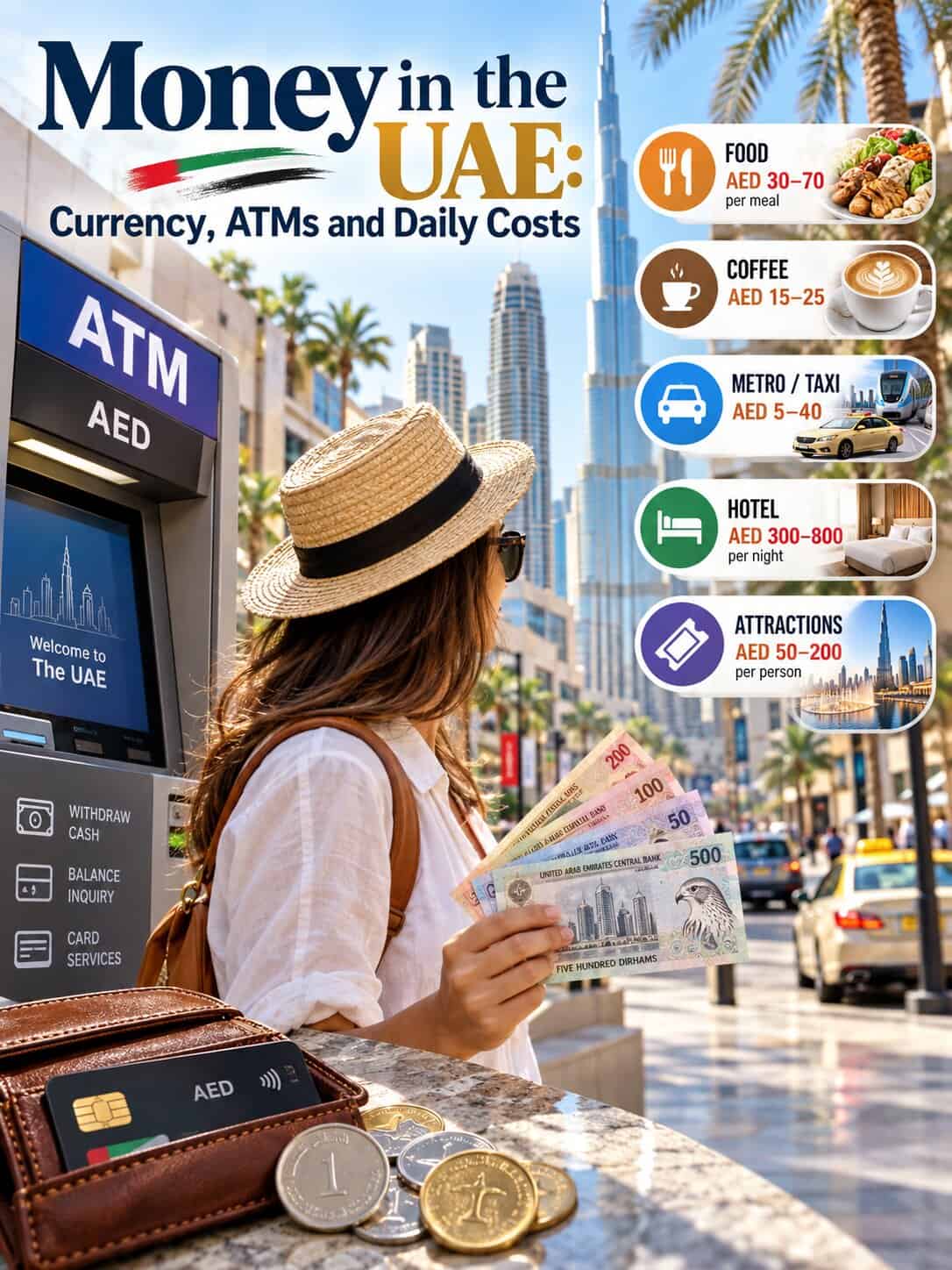
Quick answer: The UAE currency is the dirham (AED), pegged at 3.6725 AED per 1 USD, so the exchange rate is fixed. Cards work almost everywhere, and the real savings come from avoiding airport exchange counters and bad card settings.
The UAE currency is the dirham, and it is one of the easiest currencies in the world to plan around: the exchange rate is fixed, cards work almost everywhere, and the real savings come from avoiding airport exchange counters and bad card settings. This guide covers dirham basics, where to exchange, how to use ATMs and cards, how much a Dubai trip costs, and how tourist VAT refunds work. Planning the rest of the trip? Start with our complete Dubai guide and the UAE visa guide.
UAE Currency at a Glance
| Question | Answer |
|---|---|
| Currency | UAE dirham (AED), also written Dhs or DH |
| Subunit | 100 fils = 1 dirham |
| Exchange rate | Pegged at 3.6725 AED per 1 USD |
| Banknotes | 5, 10, 20, 50, 100, 200, 500 and 1,000 dirhams |
| Coins | 1 dirham, 50 fils and 25 fils are the ones you will see most |
UAE Currency Basics: The Dirham Explained
The UAE dirham (AED) is the only currency you need for daily spending. Prices on menus and receipts often show “Dhs” or “DH”, and the banknotes come in eight values, each with its own color and size. Small change is handled with 1 dirham, 50 fils and 25 fils coins, although fils are rarely used outside supermarkets and fuel stations.
Because the dirham is pegged to the US dollar at 3.6725, converting prices is simple arithmetic and does not change during your stay. Any “live” rate shown at an exchange counter is just that fixed peg plus the counter’s margin, so the margin is what you are really comparing. The table below shows the pure peg conversion before any bank or exchange markup.
| US dollars | UAE dirhams | UAE dirhams | US dollars |
|---|---|---|---|
| $10 | AED 36.73 | AED 50 | $13.61 |
| $50 | AED 183.63 | AED 100 | $27.23 |
| $100 | AED 367.25 | AED 500 | $136.15 |
| $500 | AED 1,836.25 | AED 1,000 | $272.29 |
Where to Exchange UAE Currency
Airport counters and hotel desks tend to give the weakest rates because they serve travelers who have no alternative. Licensed exchange houses such as Al Ansari Exchange operate in malls and city neighborhoods, and they usually quote better rates than airports, hotels or many banks. A practical plan is to change only enough at the airport for a taxi and a first meal, then compare two or three counters in the city before exchanging more. Many malls have several competing counters within a short walk, so the comparison takes minutes.
Rates and fees change, so always check the final amount you will receive in dirhams, not just the headline rate. If you land late and need a ride, the airport-to-Downtown guide shows what each transfer option involves, and the Dubai transport guide explains which options accept cards.
ATMs and Cards: Paying in UAE Currency
ATMs are easy to find in malls, metro stations and hotel lobbies, and they dispense dirhams. Withdrawal limits and fees depend on both the UAE bank that owns the machine and your home bank, so check your own bank’s foreign-withdrawal terms before you fly. If the ATM or a card terminal asks whether you want to pay in your home currency or in dirhams, choose dirhams. This prompt is called Dynamic Currency Conversion, and it usually gives a worse rate than letting your card issuer convert the payment.
Visa and Mastercard are accepted at hotels, restaurants, malls and most shops, including by tap-to-pay. American Express is accepted at many larger hotels and chains but is less universal, so bring a second card from another network. In Dubai, Dubai Taxi cabs have card terminals that take credit and debit cards, Apple Pay, Samsung Pay and nol cards alongside cash. Travel cards and multi-currency accounts can reduce conversion costs, but terms differ by provider and country, so read the current fee schedule before you rely on one. Cash still helps for small vendors, some taxis, markets and tips, and a modest amount of dirhams covers those gaps. If you bring cash, foreign currency or traveler’s cheques worth AED 60,000 or more into Dubai, you must declare them to Dubai Customs; its iDeclare app lets you file the declaration before or after you land.
Dubai Travel Budget: Daily Costs
Hotels drive most of the difference between a cheap and an expensive trip. The room prices below come from sampling hotel listings in Dubai for two adults across a November, a January and a July stay. They show typical middle-of-the-range nightly prices, not guaranteed rates, and individual hotels can sit well above or below them.
| Hotel class | Typical room per night (2 adults) | Approx. in AED |
|---|---|---|
| 3-star | $40-100 | AED 150-370 |
| 4-star | $55-110 | AED 200-400 |
| 5-star | $170-250 | AED 600-900 |
Summer is the cheapest time to book: the July samples came in at the low end of every range, while 5-star prices in January varied the most. If you can handle the heat, the best time to visit guide explains the trade-offs between weather and rates.
Food and getting around are easier to control. Cafeterias, food courts and local restaurants keep meals inexpensive, hotel restaurants and branded dining cost much more, and alcohol is the single biggest extra because it is only sold in licensed venues. The metro guide covers the cheapest way to move around the city, and the Dubai food guide and the halal dining guide help you eat well without overspending. Attractions, desert tours and theme parks are priced individually, so check each ticket before building a daily total.
A useful way to plan is to fix your hotel cost first, add a daily allowance for food and transport that fits your style, then list the paid experiences you actually want. Visiting both emirates? The Abu Dhabi vs Dubai comparison helps you decide where to spend your nights.
VAT Refunds on UAE Currency Purchases
The UAE charges 5% VAT on most goods and services. Eligible tourists can claim back most of it on qualifying purchases from participating retailers through the tax-free scheme. The minimum spend is AED 250 per refund transaction before VAT, receipts from different shops cannot be combined, and the scheme takes a small processing fee, so you receive most but not all of the VAT you paid. The deduction is 13% of the VAT you claim plus AED 3.60 for each tax-free transaction, and you must be at least 18 and not a UAE resident to qualify.
Ask the shop for a tax-free tag when you pay, keep the receipt, and have the goods validated at the airport before departure. Bring your passport, boarding pass and the purchases, because inspectors may ask to see them. Refunds can be paid by card or, up to a set limit, in cash. Purchases must be validated for export within 90 days of the invoice date, and you must leave the UAE within 6 hours of validation. Planet runs the validation kiosks and desks at airports, land borders and seaports; its kiosks in some malls and hotels also validate purchases if you hold an online boarding pass for a flight leaving within 24 hours. Cash refunds are capped at AED 35,000, card refunds have no cap, and a validated refund can still be claimed up to one year later.
At Dubai International, Zayed International in Abu Dhabi and Sharjah International, the refund can now run fully through the Planet app: register with a face scan and save your passport and bank card, scan the QR code at the refund point when you depart, and go to a smart gate and kiosk only if the app asks for an inspection. This paperless route pays the refund within one business day instead of about nine days on the older process.
Tipping in the UAE
Tipping is not mandatory, but it is common in restaurants, cafes, hotels and taxis. Many restaurant bills already include a service charge that may not reach the staff directly, so a small extra cash tip is appreciated. Carry some small dirham notes for this purpose, and see our tipping guide for norms by venue type.
Quick UAE Currency Checklist
UAE currency: dirham (AED), fixed at 3.6725 to the US dollar. Exchange: compare licensed exchange houses in the city instead of using the airport. Cards: Visa and Mastercard work almost everywhere, so carry a backup. ATMs and payments: decline conversion to your home currency. Budget: hotels are the largest variable, so check them first. Shopping: keep tax-free tags and receipts for the departure validation. If you also need a local number for maps and ride apps, see the SIM and eSIM guide.
Frequently Asked Questions
What is the UAE currency?
The UAE currency is the dirham (AED), divided into 100 fils. It is pegged to the US dollar at 3.6725 dirhams per dollar, so the rate stays the same throughout your trip.
Where should I exchange money in the UAE?
Licensed exchange houses in malls and city neighborhoods usually offer better rates than airport counters or hotel desks. Change only a small amount on arrival and compare a couple of counters before exchanging more.
Can I use US dollars in the UAE?
Some hotels and tourist shops may accept dollars, but the rate is set by the seller and is rarely good. Pay in dirhams or by card for the best value.
Are credit cards widely accepted in Dubai and the UAE?
Yes. Visa and Mastercard are accepted at hotels, restaurants, malls and most shops, including by contactless payment. American Express is less universal, so carry a second card.
How much cash should I carry in the UAE?
A modest amount of dirhams for taxis, small vendors, tips and markets is usually enough, because cards cover most other spending.
Can tourists get a VAT refund in the UAE?
Yes. Eligible tourists can claim back most of the 5% VAT on purchases from participating retailers through the tax-free scheme, with a minimum spend per transaction and validation at departure.
Is Dubai expensive for tourists?
Hotels are the biggest swing factor. Sampled listings show 3-star and 4-star rooms often sit well below 5-star prices, and summer rates are the lowest of the year, so Dubai works on a wide range of budgets.
Handled sensibly, the UAE currency is one of the easier parts of the trip: the fixed rate removes the guesswork, cards cover most spending, and a few small habits keep your costs close to what you planned.