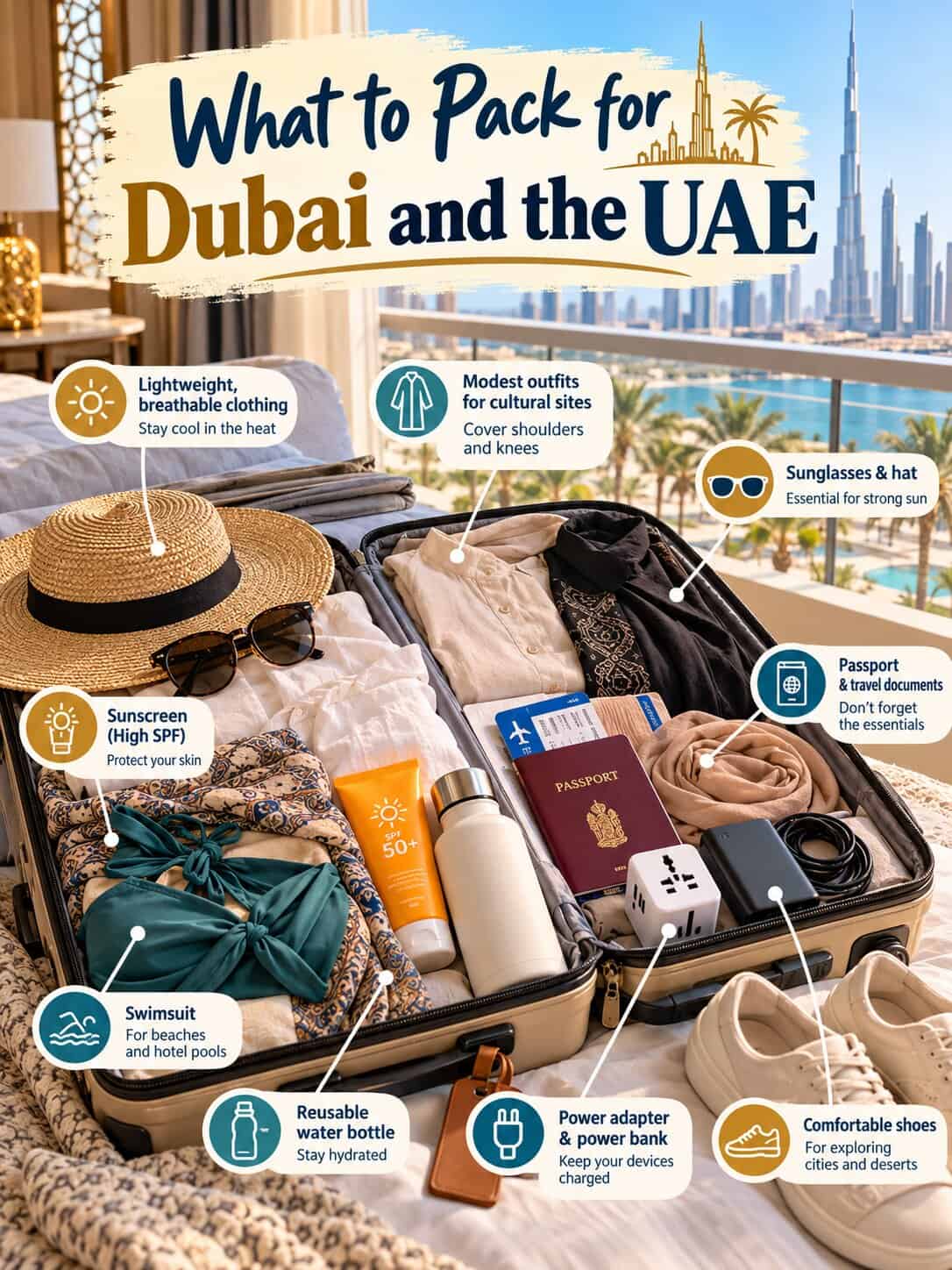
Wondering what to wear in Dubai? Pack breathable clothes for hot weather, comfortable shoes, swimwear for beaches and pools, a modest outfit for cultural sites, and a light layer for air-conditioned malls or cool winter evenings. Dubai is a cosmopolitan city, and everyday tourist clothes are widely accepted; there is no blanket legal rule requiring everyone to cover shoulders and knees in every public place. This Dubai packing list also covers mosque visits, desert safaris, sunscreen, Type G adapters and important airline and UAE medication rules. For planning the rest of your trip, see our guides to Dubai and the best time to visit.
What to Wear in Dubai: Clothing for Heat and Modesty Norms
Dubai’s official tourism authority says ordinary tourist clothing is generally acceptable, including dresses, shorts and sleeveless outfits where appropriate. Covering shoulders and knees is sensible in historic neighbourhoods, cultural attractions and government buildings, but it is not a universal legal requirement in every shopping mall or public street. Avoid transparent, offensive or excessively revealing clothes, and check individual venue dress codes. Choose light, breathable clothing that suits Dubai’s weather: cotton, linen and suitable technical fabrics can all work, depending on the activity. Pack shorts or dresses for leisure, lightweight trousers or longer skirts for conservative settings, loose tops, and one smart-casual outfit if visiting a fine-dining restaurant or rooftop venue. Include a light cardigan or shawl for heavily air-conditioned indoor spaces, even during summer. Shorts and sleeveless tops are fine in malls and tourist areas but worth swapping for something longer near older neighborhoods, government buildings, and religious sites.
What to Wear in Dubai by Location
| Location or activity | What to wear | Important detail |
|---|---|---|
| Dubai Mall and city shopping | Comfortable casual clothes, dresses, shorts or trousers | Bring an optional layer for air conditioning; avoid beachwear |
| Al Fahidi and Old Dubai | Loose tops, covered shoulders and knees | Recommended out of respect for heritage settings |
| JBR, Kite Beach, hotel pools | Swimwear or bikini; cover-up when leaving | Swimwear is appropriate in the designated beach/pool area |
| Jumeirah Mosque or Sheikh Zayed Grand Mosque | Long, opaque, loose clothes; women cover hair | Follow the individual mosque’s dress code |
| Desert safari | Breathable trousers or shorts, secure shoes | Warm layer for cool winter nights; protect from sun and sand |
| Rooftop restaurant or club | Smart casual or venue-required evening clothes | Check dress policy when reserving |
| Winter evening by the waterfront | Regular clothes plus light jacket | Wind and temperatures can feel cooler after dark |
Visit Dubai’s official clothing guide says ordinary tourist clothing is broadly accepted. Covering the shoulders and knees is context-sensitive advice, not a universal legal requirement for every outing.
Footwear and Swimwear: What to Wear in Dubai’s Pools and Streets
Comfortable walking shoes matter more than anything fashionable — malls are enormous, desert excursions involve sand, and summer pavement gets hot enough to make flip-flops a liability outdoors. Pack one solid pair of closed, breathable walking shoes plus sandals for pools and beach days. Bikinis and regular swimwear are accepted at beaches, hotel pools and waterparks. Cover up before entering malls, restaurants, hotel public areas or city streets. Swimwear at a beach or pool is not the same as being entitled to wear it throughout the entire hotel; each venue may have its own rules. Topless or nude sunbathing should be avoided.
Sun Protection Is Non-Negotiable
Pack broad-spectrum SPF 30–50+ sunscreen, sunglasses with UV protection and a hat for outdoor sightseeing. Reapply sunscreen regularly, especially after swimming. A refillable water bottle helps in hot weather, but use reliable drinking-water sources rather than counting on refill stations everywhere. Outdoor heat can be intense from May through September, so plan shaded breaks and avoid long midday walks.
Dubai Packing List: Summer vs Winter Essentials
| Item | Summer (June–September) | Winter (December–February) |
|---|---|---|
| Daytime clothes | Light, breathable outfits; spare top for heat | Light clothes, optional long trousers |
| Extra layer | Thin layer for indoor air-conditioning | Light jacket or fleece for evenings |
| Beach | Swimwear, cover-up, sandals | Swimwear, cover-up, optional wrap |
| Sun protection | SPF 30–50+, UV sunglasses, hat | SPF 30–50+, sunglasses, hat |
| Desert excursion | Breathable outfit, secure shoes, water | Long trousers, secure shoes, warm outer layer |
| Walking | Early outings and indoor breaks | Comfortable shoes for outdoor sightseeing |
Visit Dubai notes that summer temperatures can exceed 40°C, while winter days commonly reach about 25°C with cooler nights. Pack for your actual itinerary and month rather than treating the UAE as uniformly hot at every hour.
What to Wear in Dubai Mosques (If You’re Visiting One)
Visitor-accessible mosques have stricter clothing requirements than ordinary city streets. The Sheikh Zayed Grand Mosque Centre requires long, loose, ankle-length clothing for women and men; women must also wear a headscarf. The mosque is in Abu Dhabi, and visitors need to pre-book an online access pass: admission is AED 10 for visitors from outside the UAE, AED 8 through tour operators and AED 5 for Emirates ID holders. Visiting hours are 9:00 a.m. to 8:30 p.m. Saturday to Thursday, and on Friday 9:00 to 11:30 a.m. and 2:30 to 8:30 p.m. Avoid transparent, tight or sleeveless clothes. A full-length abaya is one suitable option for women, but the requirement is appropriate coverage and modest fit, not necessarily one exact garment style. Bring your own suitable mosque outfit and headscarf rather than relying on free loan abayas or scarves. Some visitor mosques may offer or sell cover-ups, but stock, availability and policies vary. The Sheikh Zayed Grand Mosque’s official visitor guidance describes required clothing and does not guarantee complimentary garments for every visitor.
Medications: What to Pack for Dubai (and What to Leave Behind)
Before packing medication, check the current UAE controlled and semi-controlled substances lists and your airline’s policies. Cannabis, THC and some CBD products can create serious legal problems; do not assume a product labelled ‘THC-free’ is safe to import. Avoid carrying poppy seeds or products containing potentially restricted ingredients unless their import status is verified. Do not equate every prescription medicine or food containing poppy seeds with the same statutory offence. Some prescription medicines, including certain opioid painkillers, sedatives and medicines for ADHD, are regulated or controlled in the UAE. Check the precise active ingredient and formulation against the Emirates Drug Establishment’s current list instead of assuming every brand or drug within a therapeutic category has identical rules. Carry supporting documentation for any medicine subject to controls. The Emirates Drug Establishment (EDE) operates a free online service for travellers importing personal controlled medicines. Its current service page says advance electronic approval is optional for visiting travellers who bring the relevant prescription/medical report and no more than three months of the patient’s required supply, subject to documentation requirements. EDE states an estimated online service completion time of one working day. The prescription must be issued within the last three months and stamped by the facility that treats you, showing your full name, the medicine name and dose, dosage form, treatment duration, issue date and doctor’s name; the medical report must be no older than one year and state the diagnosis and treatment plan. The online form requires a UAE PASS login, and a traveler who cannot submit it may carry the medicine with the prescription or medical report, within a three-month supply. However, UK FCDO travel advice currently takes a more restrictive position, advising prior approval and a one-month limit for medicines on its approval list. Because official-facing guidance conflicts, verify the active ingredient and required documents with EDE and your airline before flying; when practical, obtain written clearance rather than treating either limit as universally safe. For ordinary non-controlled medicines, use clearly labelled original packaging and carry reasonable personal-use quantities. Unlawful import, possession or supply of controlled substances can lead to serious legal penalties, and the consequences depend on the substance, quantity and circumstances, so resolve documentation questions in advance.
Dubai Packing List: Bringing Prescription Medication Safely
| Question | Current official information |
|---|---|
| Who publishes the medicine permit service? | Emirates Drug Establishment (EDE) |
| Does EDE require every visiting tourist to apply online? | Its current service page describes advance electronic approval as optional for visitors with required documents |
| EDE supply limit for visiting travellers | Up to three months of required controlled medicines, per its service FAQ and documentation rules |
| UK FCDO travel advice | Stricter: recommends advance approval and a one-month limit for drugs requiring approval |
| EDE online permit fee | Free |
| EDE estimated processing time | One working day |
| Airport transit without entering UAE | EDE indicates local import approval is not required for an airside transit without crossing immigration |
Because the EDE service and FCDO travel advice are not fully aligned, ask EDE to confirm the current rule for your actual medicine and carry the original prescription/medical report. Obtain written pre-approval when practical. Do not rely on an arbitrary ‘all controlled drugs = one-month maximum’ or ‘every drug may be carried for three months’ rule without checking its classification.
Electronics and Practical Extras
The UAE mainly uses Type G sockets (UK-style three rectangular pins) and a nominal 230 V / 50 Hz power supply. Bring a plug adapter unless your devices already fit, and check voltage compatibility for hair tools and other non-universal appliances. A power bank can help during long days, but airline battery rules matter: Emirates currently permits one clearly labelled power bank of no more than 100 Wh, in cabin baggage only; it may not be used or charged onboard or stored in overhead lockers. Airlines can set different restrictions. A local SIM or eSIM also helps with navigation — see our guide to UAE SIM cards and eSIMs.
Dubai Packing List: Power Banks and Plug Adapters
| Item | What to know |
|---|---|
| Electrical outlets | Type G (UK-style), usually 230 V / 50 Hz |
| Phone / laptop chargers | Most support 100–240 V; check the printed label |
| High-power hair tools | Check voltage compatibility; a plug adapter is not a voltage converter |
| Emirates power bank allowance | One power bank, max 100 Wh; clearly labelled |
| Where to pack a power bank | Cabin baggage only, never checked baggage |
| Emirates onboard usage | Charging or using a power bank onboard is prohibited |
| Emirates onboard storage | Under the seat or seat pocket, not overhead lockers |
| Other airlines | Check airline-specific dangerous goods rules |
Emirates’ one-power-bank rule took effect October 1, 2025. One 20,000 mAh power bank is commonly around 74 Wh at a nominal 3.7 V, but the correct rating is the manufacturer’s printed Wh value, not a capacity estimate. Do not place loose lithium batteries or power banks in checked baggage.
What NOT to Pack for Dubai
Avoid travelling with recreational drugs or unverified cannabis-derived products. For drones, verify both airline carriage rules and the current UAE and local-emirate flight authorisation requirements before packing one. Emirates allows drones only as checked baggage, with additional lithium-battery conditions; approval to carry a drone by air does not authorise flying it in Dubai. Airport security rules, airspace restrictions and drone permit conditions are separate questions. Carry practical amounts of cash, keep valuable jewellery secure and use standard travel precautions. Check customs declaration rules for large amounts of money and valuables if travelling with them. Cash, foreign currencies and traveler’s cheques worth AED 60,000 or more must be declared, and the Dubai Customs declaration list also covers jewelry, gold and other precious metals, e-cigarettes, medicines and drones. The iDeclare app lets you declare before or after you arrive at the airport.
Dubai Packing List: Quick Reference
Clothing: breathable tops, shorts or dresses for ordinary leisure, a modest outfit for heritage venues and a smart-casual look for upscale restaurants. Add a light layer for winter evenings and strong air conditioning. Footwear: walking shoes plus sandals. Beach: swimwear and a cover-up. Sun: high-SPF sunscreen, hat, UV-protective sunglasses and drinking water. Mosque visits: long, loose ankle-length clothing for both sexes and a headscarf for women; bring your own. Medicines: verify the exact EDE category and required paperwork; official-facing guidance on permit and quantity limits differs. Electronics: Type G adapter; airline-compliant power bank; eSIM or SIM. Do not pack recreational drugs, unidentified cannabis-derived products, unverified restricted medicines or drone equipment that does not meet the airline’s rules. Keep necessary documents, prescriptions and portable lithium batteries in the correct bags; do not put power banks in checked baggage.
Dubai Packing List: Seven-Day Checklist
| Category | Suggested quantity for seven days |
|---|---|
| Breathable casual tops | 5–7 |
| Shorts, trousers or skirts | 3–4 |
| Modest mosque/heritage outfit | 1 complete set |
| Smart-casual evening outfit | 1–2 |
| Swimwear | 1–2 sets, plus cover-up |
| Walking shoes | 1 pair |
| Sandals or flip-flops | 1 pair |
| Light layer or jacket | 1, with warmer layer for winter desert visits |
| Sun protection | Sunscreen, hat, UV sunglasses, lip balm |
| Travel essentials | Passport, visa where needed, insurance, bookings, bank card |
| Electronics | Type G adapter, chargers, permitted power bank, eSIM/SIM |
| Prescription medicine | Personal-use supply and necessary documentation after category check |
Treat this Dubai packing list as a starting point and adjust it to your month, hotel and activities. Quantities are planning suggestions rather than airline allowances. Pack fewer clothes if your hotel offers laundry, and check baggage weight, liquids and lithium batteries against the airline’s current rules.
Frequently Asked Questions
What should I wear in Dubai as a tourist?
Regular dresses, shorts, tops and breathable trousers are widely accepted. Bring a more modest option for cultural and religious venues, and keep swimwear for the beach, waterpark or pool. Covering shoulders and knees is guidance for conservative settings, not a citywide requirement.
What’s the biggest mistake tourists make when packing for Dubai?
The most consequential mistake can be travelling with a controlled prescription medicine without checking its precise classification and documentation. EDE and foreign government guidance differ on advance permission and quantity limits, so confirm the current rule for the actual medicine rather than relying on broad category names.
Do I need to cover my hair in Dubai?
No. Women do not need headscarves for ordinary sightseeing in Dubai. Visitor mosques such as Sheikh Zayed Grand Mosque require covered hair and modest, loose-fitting clothes. Bring a headscarf rather than assuming a garment will be lent for free.
Can I bring prescription medication to the UAE?
Generally yes, provided your medicine is lawful to bring and you follow the applicable rules. Check controlled-drug status with EDE, carry a prescription and medical report when required and confirm the allowed quantity. EDE describes online pre-approval as optional for visiting travellers, but other government travel advice recommends advance approval; obtaining confirmation before travel is prudent.
What to wear in Dubai as a woman?
Everyday dresses, shorts, T-shirts and trousers are widely accepted. For historic districts and government buildings, choose modest coverage; for mosques, wear long, loose clothing and cover your hair.
Can men wear shorts in Dubai?
Yes, shorts are common in casual tourist areas. Wear long trousers for mosque visits and when a venue specifies formal or modest attire.
Can I wear a bikini in Dubai?
Yes, on beaches and at designated pools and waterparks. Cover up before entering malls, streets, restaurants or hotel lobbies.
Do tourists need to cover their shoulders and knees?
Not as a universal citywide rule. Official tourism guidance recommends doing so in historic, cultural and religious settings.
What to wear in Dubai in July or August?
Loose, breathable clothing, a hat, UV sunglasses and high-SPF sunscreen. Add a light layer for strong indoor air conditioning.
What to wear in Dubai in December or January?
Light daytime clothing with a jacket or sweater for cool evenings and desert activities. Swimwear may still be useful on warm days.
Do mosques provide free abayas?
Do not depend on it. Sheikh Zayed Grand Mosque requires long, loose, ankle-length clothes and a headscarf for women; bring suitable garments.
Can I pack prescription medication for the UAE?
Yes, when the medicine is legal and you meet its document and quantity requirements. Consult EDE’s list, verify requirements and seek written approval where appropriate.
Can I put a power bank in checked baggage?
No. Emirates allows one clearly labelled power bank of up to 100 Wh in cabin baggage only and bans onboard use or charging.
What plug adapter do I need for Dubai?
Type G, the same plug configuration as the United Kingdom. Confirm voltage compatibility of non-universal appliances.
The essential Dubai packing list combines breathable everyday clothing, a modest outfit for religious and heritage visits, swimwear with a cover-up, sun protection, comfortable shoes and a light layer for air-conditioned spaces. Before departure, also check controlled-medicine requirements and airline battery rules. This approach answers what to wear in Dubai without overstating everyday dress restrictions.