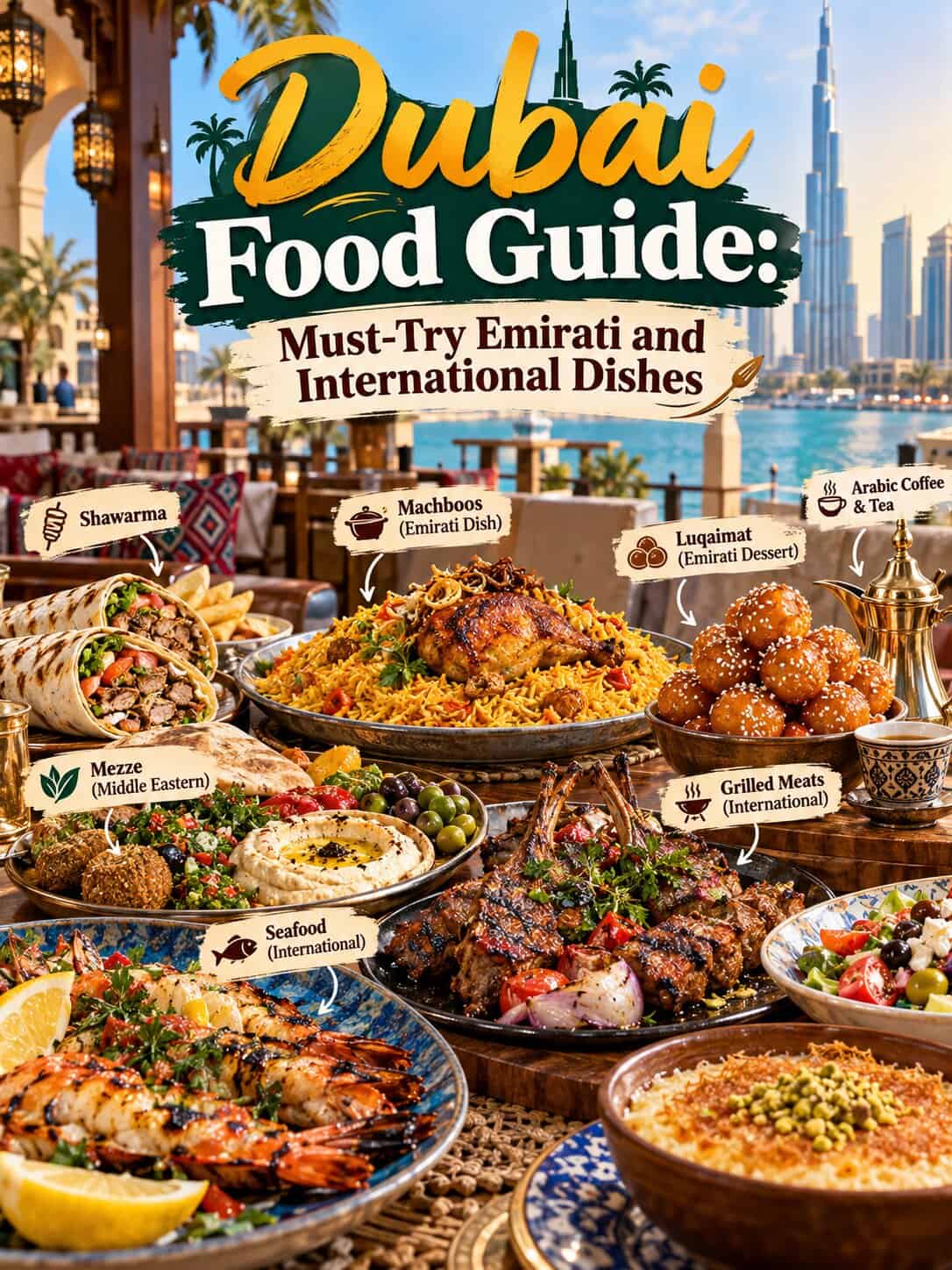
Emirati food reflects the UAE’s desert traditions, coastal fishing heritage and historic trade routes with India, Persia and East Africa. Start with machboos, harees, thareed and luqaimat, then explore local breads such as regag and khameer and the custom of serving Arabic coffee with dates. This guide to Emirati cuisine explains what the dishes contain, where to try them in Dubai, how they differ from other Middle Eastern and South Asian foods, and how to enjoy an authentic meal without confusing Dubai’s international restaurant scene with traditional UAE cooking. For the wider trip picture, see our guide to Dubai.
Emirati Food: The Quick Answer
Emirati cuisine is distinct from Dubai’s wider international restaurant scene. Traditional UAE dishes typically feature rice, seafood, meat, wheat, dates, saffron, cardamom and dried lime. Dubai also has excellent Pakistani, Indian, Filipino, Levantine and other restaurants, but these cuisines should not all be labelled Emirati food. For an authentic introduction, visit an Emirati restaurant in Old Dubai or book a hosted cultural meal in Al Fahidi. None of these three replace the others — the best food trip to Dubai touches all three rather than picking one.
Traditional Emirati Dishes to Try: Emirati Cuisine Basics
Machboos (also spelled majboos) is the closest thing to a national dish — fragrant rice cooked with chicken, lamb, or fish and warmed through with cardamom, cinnamon, cloves, and dried lime, aromatic rather than spicy, and almost always served family-style. Harees is humbler: wheat and meat slow-cooked for hours into a smooth, creamy porridge-like dish, traditionally eaten during Ramadan and other celebrations. Thareed is sometimes called Emirati bread stew — flatbread soaked in a rich meat-and-vegetable broth. Saloona is a lighter, tomato-based everyday stew with meat or fish and seasonal vegetables, served over rice or with bread. For dessert, luqaimat — crispy golden dough balls drizzled with date syrup and sometimes sesame seeds — shows up everywhere from home kitchens to hotel buffets. Drinks are an important part of Emirati hospitality. Arabic coffee, also called gahwa or qahwa, is traditionally lightly roasted, infused with cardamom and served in small cups with dates. The hospitality traditions associated with Arabic coffee are recognised by UNESCO as intangible cultural heritage. Karak is a sweet, strong milk tea with roots in the Indian subcontinent; it is popular in the UAE but should not be described as an exclusively Emirati invention.
Emirati Food: 10 Traditional Dishes Explained
| Dish | Main ingredients | When to try it |
|---|---|---|
| Machboos / Majboos | Spiced rice, chicken, lamb or fish; dried lime | Lunch or dinner |
| Harees | Wheat, meat and ghee, cooked until smooth | Ramadan, Eid or a heritage meal |
| Thareed | Thin bread soaked in meat-and-vegetable stew | Traditional lunch |
| Saloona | Spiced vegetable stew with chicken, meat or fish | Everyday home-style meal |
| Luqaimat | Fried dough balls with date or sugar syrup | Dessert or snack |
| Balaleet | Sweet vermicelli, often topped with omelette | Breakfast |
| Chebab | Thin spiced pancakes, often with date syrup | Breakfast |
| Khameer | Soft, lightly sweetened traditional bread | Breakfast or tea |
| Regag | Very thin crisp flatbread; plain or filled | Street snack or breakfast |
| Muhammar | Sweet rice with date molasses, ghee and spices | Traditionally paired with fish |
These dishes reflect the Emirati food traditions of the desert, coast and historic trade networks. Recipes vary by family and region: seafood machboos, chicken machboos and lamb machboos are all legitimate variations. Ask whether a restaurant serves a traditional UAE version rather than a similarly named dish from another Gulf country.
Where to Eat Emirati Food in Dubai
Al Fanar Restaurant & Café, with several branches around the city, is the most accessible starting point — traditionally decorated, with machboos, harees, thareed, saloona, and luqaimat all on one menu. Arabian Tea House, a historic courtyard institution, is especially known for breakfast: chebab (Emirati pancakes), khameer bread, dates, hummus, labneh, and both karak and gahwa. In Al Fahidi Historical Neighbourhood, Arabian Tea House and Al Khayma Heritage Restaurant are well-established options for local-style breakfasts, breads and rice dishes. The Sheikh Mohammed Centre for Cultural Understanding (SMCCU) runs hosted Emirati breakfast, lunch and dinner programs where guests can ask questions about local customs. Al Fanar’s Dubai Creek branch at Al Seef is its seafood market and opens at 1:00 PM daily, so it suits lunch rather than breakfast; the Dubai Festival City branch inside the mall opens at 9:00 AM. Hours change during Ramadan. Check individual outlets before travelling: restaurant branches and menus can change, and a historic name alone does not establish current operation.
Emirati Cuisine in Dubai: Where to Try It
| Restaurant or experience | Area | What to look for |
|---|---|---|
| Arabian Tea House | Al Fahidi Historical Neighbourhood | Emirati breakfast, chebab, bread and gahwa |
| Al Fanar Restaurant & Cafe | Multiple branches; Al Seef by Dubai Creek | Machboos, local seafood and nostalgic interiors |
| Al Khayma Heritage Restaurant | Al Fahidi | Traditional breakfast and heritage dishes |
| SMCCU cultural meal | Al Fahidi | Hosted Emirati breakfast, lunch or dinner with cultural discussion |
| Gerbou | Dubai, restored villa setting | Contemporary approach to Emirati dining |
| Aseelah | Radisson Blu Dubai Deira Creek | Harees and fish machboos in a modern restaurant |
SMCCU is a scheduled cultural programme rather than a walk-in restaurant: book the correct meal session in advance, and compare guided Old Dubai food and heritage tours if you prefer a hosted route. Menu items, opening days and prices can differ by branch or booking date. Arabian Tea House takes table reservations through its website.
SMCCU meals are served at House 26 in the Al Fahidi Historical Neighborhood. Breakfast is AED 130 per person on Mondays and Wednesdays at 9:00 AM, lunch is AED 145 per person from Monday to Thursday at 1:00 PM, and dinner is AED 160 per person on Tuesdays at 6:30 PM. Booking is required, with up to 11 adults per booking, and during Ramadan the Tuesday dinner is replaced by iftar.
How to Order at Al Fanar
Al Fanar calls its food traditional Emirati cooking made for sharing, and says menus vary slightly by branch, so order several dishes for the table rather than one plate each. Machboos is the anchor: rice cooked with loomi (dried lime) and spices, with meat, chicken or fish. The Seafood Market branches are known for seafood trays of fish, prawns and calamari over spiced rice, served on one tray for the whole table. For something less familiar, jesheed is shredded shark cooked with onion and Emirati spices. Luqaimat with date syrup and a glass of karak close the meal. Walk-ins are welcome, but it recommends booking for weekends, holidays and larger groups.
| Al Fanar branch in Dubai | Type | Hours |
|---|---|---|
| Al Seef, Dubai Creek | Seafood Market | 1:00 PM to 10:30 PM daily |
| Dubai Festival City, inside the mall | Restaurant and Cafe | 9:00 AM to 10:00 PM daily |
| Al Barsha Pond Park | Seafood Market | Monday to Friday 12:00 PM to 10:00 PM; Saturday and Sunday 8:30 AM to 10:00 PM |
Hours can change on public holidays and during Ramadan. The Al Seef branch has parking and valet and is part of the MICHELIN Guide Dubai restaurant selection, and the Al Barsha Pond Park branch has free parking.
Eating Out During Ramadan
Non-Muslims are not required to fast, and restaurants and food courts provide designated areas away from those who are fasting. Some restaurants adjust their hours or close during the day but open fully at iftar. Free iftar meals for the public are a common practice across the UAE, and SMCCU in Al Fahidi replaces its Tuesday dinner with iftar. Dubai’s official guidance asks non-fasting people to avoid eating, drinking and smoking in public places during fasting hours, while restaurants stay open to non-fasting guests and many offer takeaway. Ramadan arrives about 11 days earlier each year because it follows the moon, so the month falls at a different time on every trip.
Emirati Cuisine and Dubai’s International Food Scene
Dubai’s population is overwhelmingly foreign-born, and the food scene reflects it directly rather than existing as a separate “ethnic food” category — this is simply what most of the city eats on an ordinary day. South Asian cuisine (Indian, Pakistani, Sri Lankan) is everywhere and genuinely excellent; Filipino, Indonesian, Vietnamese, and Thai kitchens have a large and growing footprint; Lebanese and Iranian food sit comfortably alongside Emirati cuisine as part of the city’s broader Middle Eastern dining culture; and Chinese and Japanese restaurants round out a scene that, at the budget and mid-range level, rarely costs what visitors expect a “Dubai restaurant” to cost.
Emirati Food vs Other Popular Dubai Cuisines
| Food or drink | Cultural context | Typical Dubai setting |
|---|---|---|
| Machboos, harees, regag and luqaimat | Traditional Emirati and wider Gulf cooking traditions | Emirati restaurants and heritage meals |
| Karak tea | South Asian roots, deeply integrated into UAE café culture | Tea shops and cafeterias |
| Shawarma and falafel | Wider Levantine and Middle Eastern cuisines | Casual restaurants and takeaways |
| Pakistani karahi or biryani | South Asian cuisine | Satwa, Karama and Deira |
| Kerala meals and seafood | South Indian cuisine | Karama and other neighbourhood restaurants |
Dubai’s food diversity is a major travel attraction, but popular immigrant-community dishes should not be mistaken for native Emirati cuisine. Readers searching for local UAE cooking should look for traditional dishes and specialist restaurants first.
Karama: Dubai’s “Curry Corridor”
Al Karama is a useful neighbourhood for budget-friendly South Asian and other international restaurants, including Kerala-style seafood, biryani and casual cafés. It is not the primary place to find traditional Emirati home cooking. For Emirati food, prioritise Al Fahidi, Al Seef or a dedicated Emirati restaurant instead; for international dining, explore Karama, Satwa, Deira and Bur Dubai. Calicut Paragon is a go-to for Kerala-style seafood, and Dapoer Kita covers Indonesian specialties. Budget restaurants in Karama often offer individual dishes or set meals at modest prices, but any price estimate is rough and changes by restaurant, so check the current menu and service charges. For broader daily travel costs, see our guide to money in the UAE for how food costs fit into a wider daily budget.
Satwa and Old Dubai: Street Food Beyond Emirati Cuisine
Satwa functions as the city’s street food hub, anchored by Ravi Restaurant — a Pakistani institution operating since the early 1980s — and Al Mallah, known for shawarma, falafel, and grilled meats served well into the evening. Over in Deira and Bur Dubai, heritage dining runs even deeper: Al Ustad Special Kabab has been grilling since 1978, and the older shopping centers still hold food courts that predate most of the city’s glass-tower skyline. A shawarma wrap here typically costs AED 8-15 — a useful benchmark for how far a modest food budget stretches away from the tourist strip.
Fine Dining, Michelin Stars and Emirati Cuisine
Dubai’s culinary scene also includes internationally recognised fine dining. The October 2026 fifth edition of the Michelin Guide Dubai launched in 2022 and now recognises 20 Michelin-starred Dubai restaurants in its 2026 selection: 14 with one star, four with two stars and two with three stars. The selection also includes 22 Bib Gourmand restaurants and 80 other selected restaurants, making 122 restaurants across 38 cuisine types. Orfali Bros was promoted to two stars, while Birch and KIGO gained their first stars. The three-star tier includes FZN by Björn Frantzén (Nordic-Asian fusion at Atlantis, The Palm) and Tresind Studio (a modern Indian tasting menu on Palm Jumeirah) — proof that the city’s reputation for serious cooking, not just spectacle, is now backed by one of the most conservative rating systems in the industry.
Emirati Cuisine and Dubai’s MICHELIN Guide 2026
| MICHELIN 2026 category | Restaurants |
|---|---|
| Three stars | 2 |
| Two stars | 4 |
| One star | 14 |
| All starred restaurants | 20 |
| Bib Gourmand | 22 |
| Other MICHELIN-selected restaurants | 80 |
| Total restaurants in 2026 selection | 122 |
The fifth MICHELIN Guide Dubai edition was announced in early October 2026. FZN by Björn Frantzén and Trèsind Studio hold three stars; Orfali Bros joined the two-star category. This is a separate contemporary restaurant scene and should not be equated with traditional Emirati cuisine.
Weekend Brunch After Emirati Food: A City Institution
Dubai’s weekend brunch tradition is a multi-hour restaurant or hotel dining experience, often featuring buffets or set sharing menus and optional beverage packages. Saturday and Sunday brunches are also common after the UAE’s working-week change, so visitors should not assume every brunch happens on Friday. Opening times, menus, family access and drinks packages depend on the venue. Brunch prices vary significantly by restaurant, date, drinks package and age category, so check a specific dated menu before booking. Some venues sell soft-drink packages, alcoholic-drink packages, à la carte weekend lunch or family-friendly options. Since alcohol service is tied to the venue’s license, see our guide to Dubai alcohol and dress code rules for the broader context on where and how that actually works.
Dubai Food Festival and Taste of Dubai
Dubai’s food calendar has its own dedicated events beyond the daily scene. Taste of Dubai, held annually in early February (the 2026 edition ran February 6-8 at the Dubai Media City Amphitheatre), is a three-day grazing festival built around taster-sized portions from roughly nine featured restaurants, celebrity chef demonstrations, and hands-on cooking workshops. The organiser confirms that Taste of Dubai ran February 6–8, 2026, at Dubai Media City Amphitheatre, but has not yet announced 2027 dates or ticket prices. There is no dedicated parking at the venue and only limited paid parking around it, so a taxi or public transport is the easier way in, and anyone buying alcohol has to show ID proving they are 21 or older. Past ticket products included General Admission, Taster and VIP packages with different food and drink voucher allocations. If a future edition lines up with your trip, it is a genuinely efficient way to sample a wide cross-section of the city’s restaurant scene in a single afternoon rather than booking separately all week.
Dubai Food Festivals: What Is Confirmed for 2027?
| Event | Details | Still to be announced |
|---|---|---|
| Taste of Dubai | 2026 edition: February 6–8, Dubai Media City Amphitheatre | 2027 dates and ticket prices not yet published |
| Dubai Food Festival | Separate citywide programme of culinary events | Dates and participating venues for a specific future edition |
Taste of Dubai’s organisers describe General Admission, Taster and VIP ticket products, but the official FAQ currently says to await 2027 prices. Taste of Dubai and Dubai Food Festival are not the same event.
Emirati Food Guide: Quick Reference
Emirati dishes to try: machboos, harees, thareed, luqaimat, karak tea, Arabic coffee. Where to try them: Al Fanar, Arabian Tea House, Local House Restaurant, SMCCU. Budget international food: Karama (South/Southeast Asian budget meals), Satwa and Deira (street food and legacy eateries). Fine dining: the MICHELIN Guide Dubai 2026 lists 20 starred restaurants (14 one-star, 4 two-star and 2 three-star), plus 22 Bib Gourmand restaurants. Weekend brunch: prices depend on the venue and drinks package. Annual event: Taste of Dubai took place February 6–8, 2026; 2027 dates and ticket prices have not been announced yet.
Emirati Food: A Half-Day Tasting Route in Old Dubai
| Time | Stop | Try |
|---|---|---|
| 9:00–10:00 AM | Al Fahidi: Arabian Tea House or Al Khayma | Chebab, khameer, balaleet and gahwa |
| 10:00–11:00 AM | Al Fahidi heritage lanes | Short cultural walk; optional Coffee Museum |
| From 1:00 PM | Al Seef: Al Fanar Restaurant | A seafood dish; the Al Seef branch is Al Fanar’s seafood market |
| Mid-afternoon | Local café or dessert stop | Luqaimat with date syrup |
The route focuses on Emirati food rather than adding restaurants across the entire city. For a deeper hosted meal, reserve a SMCCU session and replace one restaurant stop. A visit to the heritage streets is free; meals and cultural programmes are charged separately.
What to Order If You Have Just One Emirati Meal
Choose a chicken or fish machboos as a main course, sample harees or thareed if offered, finish with luqaimat and take gahwa with dates. Ask whether the restaurant has a sharing platter if you want several tastes without ordering full individual portions.
Frequently Asked Questions
What is the most popular traditional Emirati dish?
Machboos (also called majboos) — a spiced rice dish with chicken, lamb, or fish, cardamom, cinnamon, cloves, and dried lime — is the closest thing to a national dish and the easiest traditional dish to find on a menu.
Where can I try authentic Emirati food in Dubai?
Al Fanar Restaurant & Café, Arabian Tea House, and Local House Restaurant in the historic Al Fahidi neighborhood are the most accessible options, alongside communal cultural meals run by the Sheikh Mohammed Centre for Cultural Understanding.
What is the cheapest area to eat in Dubai?
Karama, known locally as the city’s “curry corridor,” has hundreds of South and Southeast Asian restaurants with budget meals that are usually cheaper than mall food courts or tourist-area restaurants.
Does Dubai have Michelin-starred restaurants?
Yes. The October 2026 Michelin Guide Dubai names 20 starred restaurants: 14 with one star, four with two stars and two with three stars. FZN by Björn Frantzén and Trèsind Studio retain three stars; Orfali Bros was promoted to two stars.
What is Dubai’s Friday brunch?
A long, sociable hotel or restaurant meal, offered on various weekend days rather than Friday alone. Prices depend on the venue, drinks, children’s policy and package; check the current restaurant menu instead of relying on a fixed citywide range.
Is street food safe and common in Dubai?
Yes — areas like Satwa and Deira have decades-old, well-established street food and legacy restaurants (some operating since the late 1970s and early 1980s) that are a normal, safe, and affordable part of daily life for much of the city.
What is Emirati food?
Emirati food is the traditional cuisine of the UAE, shaped by coastal fishing, desert living and centuries of trade. Important ingredients include rice, seafood, meat, wheat, dates, saffron, cardamom and dried lime.
What are the most famous Emirati dishes?
Machboos, harees, thareed, saloona, luqaimat, balaleet, regag, khameer and chebab are popular dishes or breads to seek out.
Is machboos the national dish of the UAE?
Machboos is widely regarded as a signature or unofficial national dish, prepared with spiced rice and chicken, lamb or fish. There is no need to claim that one recipe is the only official national dish.
What is a traditional Emirati breakfast?
Try chebab pancakes, khameer bread, balaleet sweet vermicelli, regag flatbread and Arabic coffee served with dates.
Is karak tea originally Emirati?
Karak has South Asian roots and is extremely popular in Dubai. Arabic gahwa with dates is more directly associated with traditional Emirati hospitality.
Is Emirati food spicy?
Many dishes are aromatic rather than hot, using saffron, cardamom, cinnamon, dried lime and cloves. Ask about chilli or other additions if you prefer mild food.
How many Michelin-starred restaurants are in Dubai in 2026?
The October 2026 guide lists 20: 14 one-star, four two-star and two three-star restaurants.
When is Taste of Dubai 2027?
2027 dates and ticket prices have not been announced yet. The last edition ran February 6–8, 2026.
Is traditional Emirati food vegetarian?
Many main dishes contain meat, fish or meat stock, but breads, dates, some vegetable sides and desserts can be vegetarian. Ask about ghee, meat broth and fillings.
A good Dubai food guide ultimately comes down to not picking just one lane — a few Emirati dishes at a traditional restaurant, a budget meal in Karama or Satwa, and at least one splurge, whether that’s a Michelin-starred tasting menu or a Friday brunch, cover the full range of what the city’s food scene actually offers.