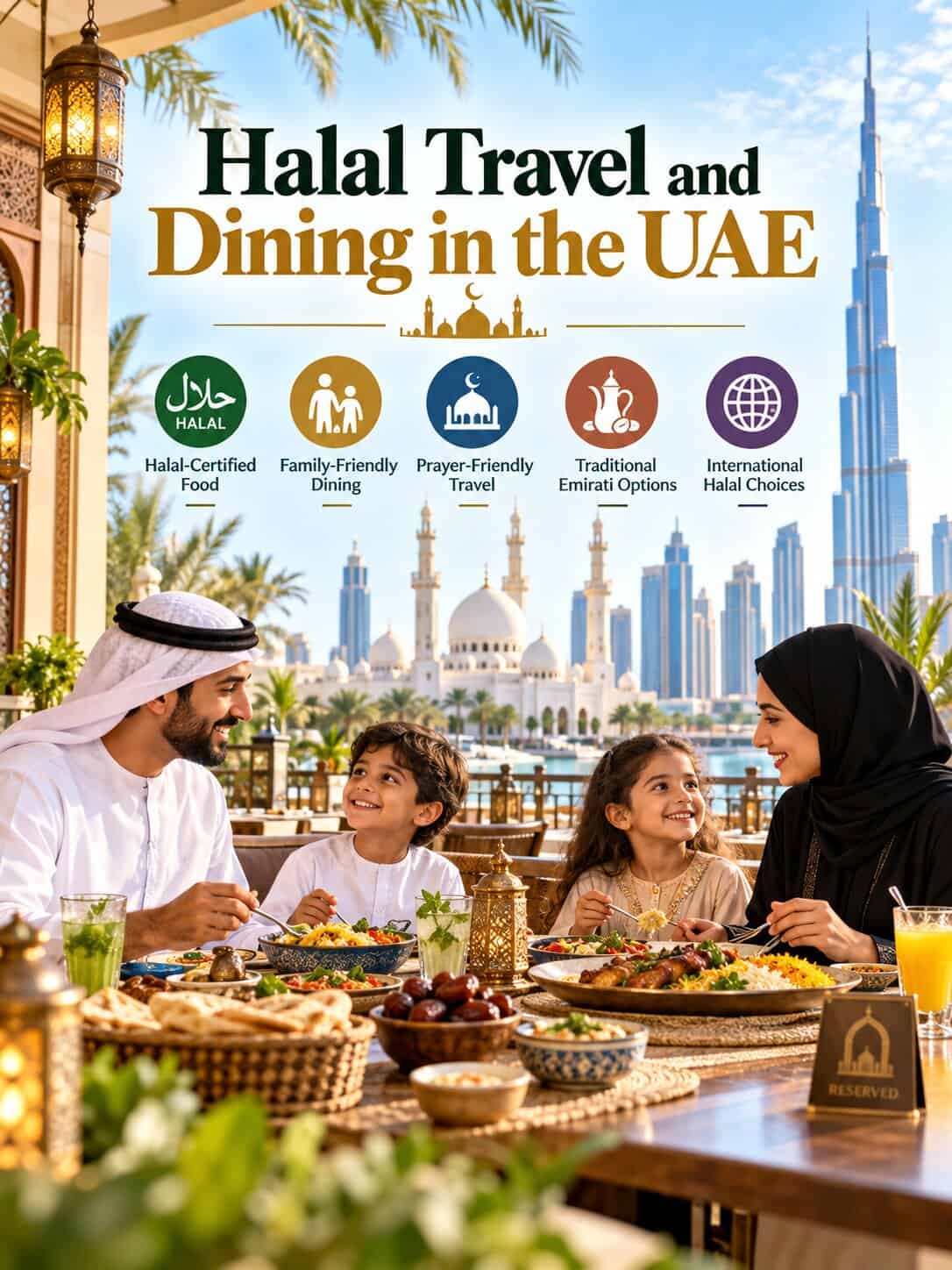
Finding halal food Dubai visitors can enjoy is generally straightforward: halal meat and Muslim-friendly meals are widely available across the UAE, from casual cafeterias to Emirati restaurants. However, not every restaurant or imported food product is individually halal-certified, and some licensed outlets serve pork or alcohol. This guide explains how to verify halal restaurants UAE travellers may choose, find prayer rooms in UAE malls, identify suitable halal-friendly hotels and understand Ramadan dining etiquette. This guide covers food, prayer, mosques, and the practical etiquette around all three. For the wider trip picture, see our guide to Dubai.
Halal Food Dubai: The Quick Answer
Halal meat and Muslim-friendly food are widely available throughout the UAE, but it is inaccurate to claim that every food item or every restaurant has a separate halal certificate. The UAE operates a national system for halal-product certification and conformity assessment. Its Halal National Mark, administered by the Ministry of Industry and Advanced Technology (MoIAT), is a voluntary mark for qualifying products, services or production systems; verify any specific business certification rather than assuming it from a general operating licence. Pork products and alcoholic drinks are regulated and sold or served at authorised businesses, but the precise arrangements depend on the outlet and emirate. A menu, hotel or restaurant should not be described as fully halal without considering all ingredients and food preparation. Prayer facilities are easy to find — major malls and many airport terminals have dedicated prayer rooms, and roadside availability depends on the stop — and mosque visits for non-Muslim and Muslim tourists alike are well organized, with Jumeirah Mosque’s public tour being the most accessible starting point.
Is All Food in the UAE Halal? Halal Food Dubai Explained
No: halal food is widespread, but not every food item sold in the UAE has a separate halal certification. The Ministry of Industry and Advanced Technology (MoIAT) is responsible for the UAE Halal National Mark and registration of halal certification bodies. The national halal standards framework includes UAE.S 2055-1 for halal food requirements and UAE.S 2055-2 for certification bodies. The former ESMA name is outdated for the national mark. Food-safety permits and business licences should not automatically be equated with a halal certificate for every restaurant dish. Mainstream supermarket meat counters commonly supply halal meat, but travellers who require documented assurance should check the product label, supplier or butcher, especially for imported processed meat and unusual ingredients. Many restaurants serve halal dishes, but a food-service licence is not the same as independent halal certification of the entire menu, kitchen or restaurant. Ask whether meat is halal-sourced and whether pork, alcohol-based ingredients or shared cooking equipment are used if those details matter to you.
Halal Food Dubai: When You Should Verify a Restaurant
| Dining situation | Practical verification |
|---|---|
| Emirati restaurant | Ask whether meat is halal-sourced and if all preparation is halal |
| International hotel restaurant | Check pork, alcohol-containing sauces and shared kitchens |
| Food court | Check the specific operator, not just the mall |
| Imported snacks or sweets | Review gelatin, enzymes, lard, flavourings and certification |
| Supermarket meat | Check packaging, supplier and label for assurance |
| Strictly alcohol-free dining | Verify the entire venue’s beverage policy |
MoIAT’s UAE Halal National Mark is voluntary and may cover qualified products, services and systems. Certification by a recognised body gives stronger evidence than assuming all licensed restaurants are halal. A restaurant that serves halal meat is not automatically a fully halal-certified or alcohol-free establishment.
How to Identify Halal Food Dubai Restaurants and Products
When buying packaged foods or eating at international restaurants, check both product certification and ingredient information. Gelatin, lard, meat extracts, certain flavourings and alcohol-containing ingredients can require closer scrutiny. Local manufacture alone does not prove certification, and imported products are not automatically non-halal. Look for the UAE Halal National Mark issued under MoIAT’s current system or certification from a body whose approval is recognised for the relevant product and market. MoIAT publishes a searchable register of registered halal certification bodies. Do not assume all logos from overseas organisations have blanket approval for every UAE import category. For verification, use the Ministry of Industry and Advanced Technology’s current halal programme and registered-certification-body listings since the former ESMA is no longer the active federal issuer of the national halal mark.
Halal Food Dubai: Where Pork and Alcohol Are Sold
Some authorised UAE supermarket outlets sell pork or pork-containing products in designated non-Muslim sections. Availability depends on emirate, retailer, specific branch and current authorisation; do not promise that every Spinneys, Carrefour or Choithrams stocks pork, or that every branch of another chain has an identical permanent policy. Check shelf labelling and ingredient lists when buying prepared food. Alcohol may be served in licensed hotel restaurants, bars and other authorised venues in Dubai and some other emirates; Sharjah is a dry emirate. A restaurant may offer halal meat while also serving alcoholic beverages, so travellers who want a completely alcohol-free venue should verify the whole outlet’s policy, not merely the source of its meat. See our guide to Dubai alcohol and dress code rules for the full legal picture on where and how alcohol is actually served.
Dubai’s customs guidelines for arriving travelers allow up to 4 liters of alcohol or 2 cartons of beer, each carton holding 24 cans of up to 355 ml. Anything above that allowance is subject to customs duty plus VAT.
Emirati Halal Food Dubai Dishes to Try
Traditional Emirati dishes to try include machboos, rice cooked with spices and chicken, lamb or fish; harees, slow-cooked wheat with meat; thareed, bread soaked in a savoury stew; and luqaimat, fried dough served with date syrup. These are typically prepared in halal-friendly ways, but meat sourcing and preparation should still be verified at individual restaurants. Arabic gahwa with dates is central to Emirati hospitality; karak is a popular spiced milk tea with South Asian roots. Our Dubai food guide has the fuller list, including exactly where in the city to find each dish.
Halal Restaurants UAE: Dishes and Dining Areas
| Where | What to try | Tip |
|---|---|---|
| Al Fahidi / Al Seef, Dubai | Machboos, harees, thareed, regag | Seek specialist Emirati restaurants |
| Deira and Bur Dubai | South Asian and Emirati café food | Confirm meat sourcing at the chosen venue |
| Al Karama | Indian, Pakistani and other cuisines | Not every international restaurant has identical certification |
| Sharjah | Traditional Gulf meals and family restaurants | Emirate prohibits alcohol |
| Abu Dhabi | Local seafood, rice dishes and heritage dining | Confirm outlet-specific pork and alcohol policies |
For halal restaurants UAE visitors should distinguish between a halal dish, a kitchen that uses halal meat and a business with a recognised certification for the full operation. Restaurant status and menus can change, so do not apply a blanket certification claim to a named brand without evidence. The same caution applies to any halal food Dubai guide or review you read online.
Halal Travel and Dining in the UAE: Prayer Facilities
Prayer facilities are widely available in major UAE shopping malls, many airport terminals and numerous public venues, but they should not be promised at every highway rest stop or small commercial building. Dubai Mall explicitly lists separate prayer rooms for men and women and provides locations through its app, interactive maps and guest service desks. Many hotels provide a Qibla direction indicator or prayer mat, but these are not guaranteed amenities at every property. Ask whether a mat, Qibla marker, prayer room and access to a nearby mosque are available before booking; also check whether the hotel operates licensed bars or pork-serving kitchens if an alcohol-free property is important. Use current prayer timetables from the relevant UAE religious authority or a trusted app configured for the city you are visiting. Daily prayer times vary by date and location, and calculation methods can differ; check the local mosque timetable for Friday congregational prayers.
Prayer Rooms in UAE: Finding Facilities While Sightseeing
| Venue | What is known | How to find it |
|---|---|---|
| Dubai Mall | Officially confirms separate prayer rooms for men and women | Dubai Mall app, Touchmaps or Concierge Desk |
| Major UAE airports | Prayer rooms are generally provided in main terminals | Airport signs and terminal maps |
| Shopping centres | Many provide prayer facilities and ablution areas | Search for Prayer Room or Musalla; ask guest services |
| Hotels | Prayer mat and Qibla direction vary by hotel | Ask reception before or during your stay |
| Road trips | Some service areas offer designated facilities | Identify a mosque or verified rest stop in advance |
Prayer times depend on the local city and date, so plan your halal food Dubai meals around them when you can. For Friday prayers, expect mosques to be busier around the congregational prayer period and check access arrangements for visitors.
Mosque Visits for Tourists: Jumeirah Mosque and Beyond
Jumeirah Mosque’s “Open Doors, Open Minds” program, running since 1998, is the most accessible mosque visit in Dubai for non-Muslim tourists specifically — guided sessions run at 10am and 2pm, Saturday to Thursday (closed Fridays), with registration opening 30 minutes before each session and no advance booking required. The AED 55 ticket includes light Emirati refreshments and a full Majlis session covering Islamic practices like ablution, with time for questions. For a larger-scale version of the same idea, our Sheikh Zayed Grand Mosque visitor guide covers Abu Dhabi’s equivalent, which is considerably bigger and typically takes longer to see properly.
For a hosted Emirati meal with time for questions about local customs, the Sheikh Mohammed Centre for Cultural Understanding in the Al Fahidi Historical Neighborhood serves breakfast at AED 130 per person on Mondays and Wednesdays at 9:00 AM, lunch at AED 145 from Monday to Thursday at 1:00 PM and dinner at AED 160 on Tuesdays at 6:30 PM. Booking is required, and during Ramadan the Tuesday dinner is replaced by iftar.
Jumeirah Mosque Dubai: Tourist Visit Details
| Item | Published information |
|---|---|
| Guided public visits | 10 AM and 2 PM |
| Days | Saturday–Thursday; closed Friday |
| Entry fee | AED 55 per person |
| Registration | Opens 30 minutes before the visit |
| Advance booking | Not required for regular public sessions |
| Included | Light Emirati refreshments and Majlis programme |
| Clothing | Modest dress; women should bring a headscarf |
Registration takes place at the Majlis, where the guided session runs, and photography is welcome during the visit. Men should avoid shorts and sleeveless tops, and women’s clothing should cover arms, legs and hair. Kanduras for men and abayas and headscarves for women are provided for visitors who need them, though bringing your own suitable clothing avoids relying on what is on hand. Other mosques have different public access and dress requirements.
Halal-Friendly Hotels and Amenities
The UAE offers both mainstream hotels with halal dining options and properties marketed as alcohol-free or Muslim-friendly. However, ‘halal-friendly’ is not a universal hotel certification standard, and separate pools, women-only spa sessions, alcohol-free minibars or pork-free kitchens must be checked individually. Ask the hotel for its current written amenity policy before booking rather than assuming every Muslim-friendly property includes all these facilities. Visitors can find Muslim-friendly accommodation in Deira, Bur Dubai, Al Barsha and Sharjah, as well as other districts. Choosing a location should depend on transport, prayer access, meal preferences and the individual property’s facilities. Sharjah has stricter alcohol rules than Dubai, but that alone does not guarantee a specific hotel has a private prayer room or women-only pool. Most mainstream hotels, even non-alcohol-free ones, still serve halal food as their default kitchen policy — it’s specifically the bar and pork-serving restaurant that are the exception, not the rule.
Halal-Friendly Hotels UAE: A Booking Checklist
| Feature | Question to ask the hotel |
|---|---|
| Halal food | Are all meats halal-sourced, or is only a separate halal menu offered? |
| Alcohol-free policy | Is the entire property dry, including minibar, restaurants and events? |
| Pork-free kitchen | Are pork products prepared in any hotel kitchen? |
| Prayer mat and Qibla | Are these provided in every room or on request? |
| Women-only facilities | Are there separate hours or spaces, and what dates apply? |
| Ramadan dining | Are Suhoor and Iftar meals available, and is service included in room rate? |
| Location | How far is the nearest mosque, Metro or attraction? |
A hotel’s marketing description as ‘Muslim-friendly’ does not prove all seven features. Request confirmation before paying for a non-refundable booking, especially if halal food Dubai hotels advertise is a deciding factor for your stay. Compare total room prices rather than assuming a halal-friendly property always costs more.
Halal Travel and Dining in the UAE: Modest Dress and Beach Etiquette
Standard swimwear is accepted at beaches and pools, and modest swimwear is common, but individual beach clubs and hotel pools may set their own clothing and access rules. Women-only sessions or areas are venue-specific, not universal; confirm the date, eligibility and booking conditions of the actual facility. Outside beaches, modest clothing is recommended, particularly in heritage districts, shopping centres and government buildings. Covering shoulders and knees is a conservative guideline rather than a fixed legal requirement everywhere. Mosque visits have stricter rules, usually requiring covered arms and legs and a headscarf for women. Bring your own suitable clothing rather than assuming free loan garments are available at every mosque.
Halal Food Dubai in Ramadan: Rules for Visitors
During Ramadan, Muslims who are fasting abstain from food and drink between dawn and sunset. Non-Muslim visitors are not required to fast. The UAE government’s Ramadan guidance says non-Muslims can find daytime dining in mall restaurants and food courts, often in designated areas, and that tourist attractions remain open. Be respectful when eating around people who are fasting and follow venue-specific arrangements. UAE government guidance states that some restaurants operate designated daytime dining areas during Ramadan, while others adjust their hours or close during the day and open fully at iftar. Free iftar meals for the public are a common practice across the UAE. Hotels and tourist attractions continue operating, and cities become lively after Iftar. Paid street parking hours also change during Ramadan, which matters if you drive to an iftar. See our UAE public holidays and festival calendar for Ramadan’s exact dates and how it fits into the wider year.
Ramadan Dining in the UAE: Current Tourist Guidance
| Question | Current UAE government visitor guidance |
|---|---|
| Must non-Muslim tourists fast? | No |
| Can visitors buy food during the day? | Yes, many mall restaurants and food courts provide dining areas |
| Do attractions close for the full day? | No; attractions generally remain open |
| Do restaurant hours change? | Some close or adjust service before Iftar |
| What is Iftar? | The sunset meal that breaks the fast, often starting with dates and laban |
| What is Suhoor? | The pre-dawn meal before a day of fasting |
| What needs extra planning? | Restaurant reservations, late-night schedules and taxis near Iftar |
UAE government guidance explicitly permits non-Muslims to find daytime dining in designated mall facilities. Visitors should remain respectful and follow the venue’s arrangements, whether they are looking for halal food Dubai restaurants or a quick snack in a mall.
Halal Food Dubai: Budgeting and Practical Tips
Everyday halal food in Dubai spans street cafeterias, local restaurants, premium dining and supermarkets, so there is no single halal-food price category. Genuine certification, specialist menus and restaurant location may affect individual prices; do not claim a universal absence of any price difference without comparing specific venues. An alcohol-free or Muslim-friendly hotel does not necessarily cost more than a mainstream property. Compare total room prices, taxes, meal plans, cancellation policy and the actual availability of women-only facilities, prayer mats and halal kitchens. A UAE-specific prayer-times and Qibla app is worth downloading before arrival, and scheduling flexibility around prayer times and, if traveling during Ramadan, around sunset Iftar meals, makes the logistics noticeably smoother.
Halal Food Dubai: Quick Reference
Food: halal meals are widespread, but check specific meat and ingredient certification when required. MoIAT administers the national halal mark; the mark is voluntary and food-business licences do not certify every dish. Pork: selected authorised shops and venues, varying by branch and emirate. Alcohol: authorised venues in some emirates; Sharjah prohibits alcohol. Prayer: separate facilities confirmed at major sites such as Dubai Mall, not universally at every roadside stop. Jumeirah Mosque visits: 10 AM and 2 PM Saturday–Thursday, no prior booking; register 30 minutes in advance; the fee is AED 55 per person. Ramadan: fasting Muslims abstain from food and drink during daylight; non-Muslims need not fast and can use daytime restaurant services that remain open. Tourist attractions and many dining venues operate with modified hours.
Frequently Asked Questions
Can non-Muslims visit mosques in Dubai?
Yes — Jumeirah Mosque runs a public “Open Doors, Open Minds” program specifically for non-Muslim visitors, with guided sessions at 10am and 2pm, Saturday to Thursday, AED 55 per person, no advance booking required.
Is alcohol illegal in the UAE?
Alcohol is permitted in licensed venues in Dubai and several other emirates, while Sharjah prohibits it. A venue’s halal meat sourcing does not automatically prove it is completely alcohol-free. Alcohol is not normally sold in ordinary grocery aisles.
Are there halal-only hotels in the UAE?
Yes, some hotels are alcohol-free or offer Muslim-friendly services, but facilities vary. Ask the hotel whether its kitchen is halal-only, alcohol is absent throughout the property, prayer mats or Qibla markers are available and women-only pool or spa times exist.
Where can I find prayer rooms in Dubai?
Dedicated prayer rooms are available at many major malls and airports. Dubai Mall confirms separate male and female facilities and provides directions through its maps and help desks. Highway and hotel amenities vary; confirm with the relevant site.
Is food in the UAE halal?
Halal meat and meals are widely available, but not every product, menu or restaurant is independently halal-certified. Check the operator’s sourcing, ingredients and certification if strict assurance is necessary.
Who issues the UAE Halal National Mark?
The Ministry of Industry and Advanced Technology (MoIAT) administers the current national mark and registers halal certification bodies. The mark itself is voluntary.
Where can I find halal food Dubai restaurants?
Emirati venues around Al Fahidi and Al Seef, local cafeterias and many international restaurants offer halal dishes. Confirm whether the entire kitchen or only selected meals meet your requirements.
Can restaurants serve halal meat and alcohol?
Some licensed restaurants may offer halal-sourced meat and alcoholic drinks. For an alcohol-free venue, check the complete beverage policy separately.
Are pork products sold in Dubai?
Yes, at authorised retailers or venues. Their availability and labelling depend on the outlet and location.
Where are prayer rooms in UAE malls?
Many major malls have prayer facilities. Dubai Mall specifically confirms rooms for men and women and provides locations through its maps and concierge staff.
Is Jumeirah Mosque open to non-Muslim visitors?
Yes. Guided visits run at 10 AM and 2 PM Saturday–Thursday and require registration 30 minutes beforehand without advance booking. The fee is AED 55 per person.
How do I find halal-friendly hotels in the UAE?
Ask whether the property is alcohol-free, uses halal-only kitchens and provides prayer amenities and women-only facilities. These are not universal features of every hotel.
Can tourists eat in Dubai during Ramadan?
Non-Muslims need not fast. Current UAE government guidance confirms that designated daytime dining is available in malls and other restaurants, subject to venue hours.
What modest clothing should tourists wear at mosques?
Visitors generally need covered arms and legs, with a headscarf for women. Bring your own appropriate clothing and follow each mosque’s visitor policy.
Halal food Dubai travellers can find is plentiful, and UAE malls, mosques and many hotels make prayer planning relatively easy. Still, confirm the restaurant’s meat and ingredient standards, understand differences in pork and alcohol licensing between emirates, and check each hotel’s promised facilities. During Ramadan, non-Muslims can use designated daytime dining services while respecting fasting customs.